How to Become a Loan Officer in 7 Days: Key Requirements
Start Your Path to Becoming a Loan Officer
To learn how to become a loan officer, start by getting an NMLS ID, completing required pre-licensing education, passing the SAFE Mortgage Loan Originator Test, clearing background and credit reviews, and applying for a Florida MLO license. You then need sponsorship from a licensed mortgage lender or broker before you can originate loans.
A focused seven-day plan can help you begin the education and application process quickly. But the full approval timeline depends on course completion, exam scheduling, fingerprinting, state review, and employer sponsorship.
For people in Tampa, St. Petersburg, Clearwater, and nearby communities, this career can combine financial analysis with real human problem-solving. A loan officer helps buyers understand financing options, gather documents, navigate underwriting, and move from application to closing with fewer surprises.
I’m Josh Jampedro, a Tampa mortgage broker and vice president with more than 10 years of experience and 1,000-plus closed transactions, and I’ll break down what the licensing path really involves.
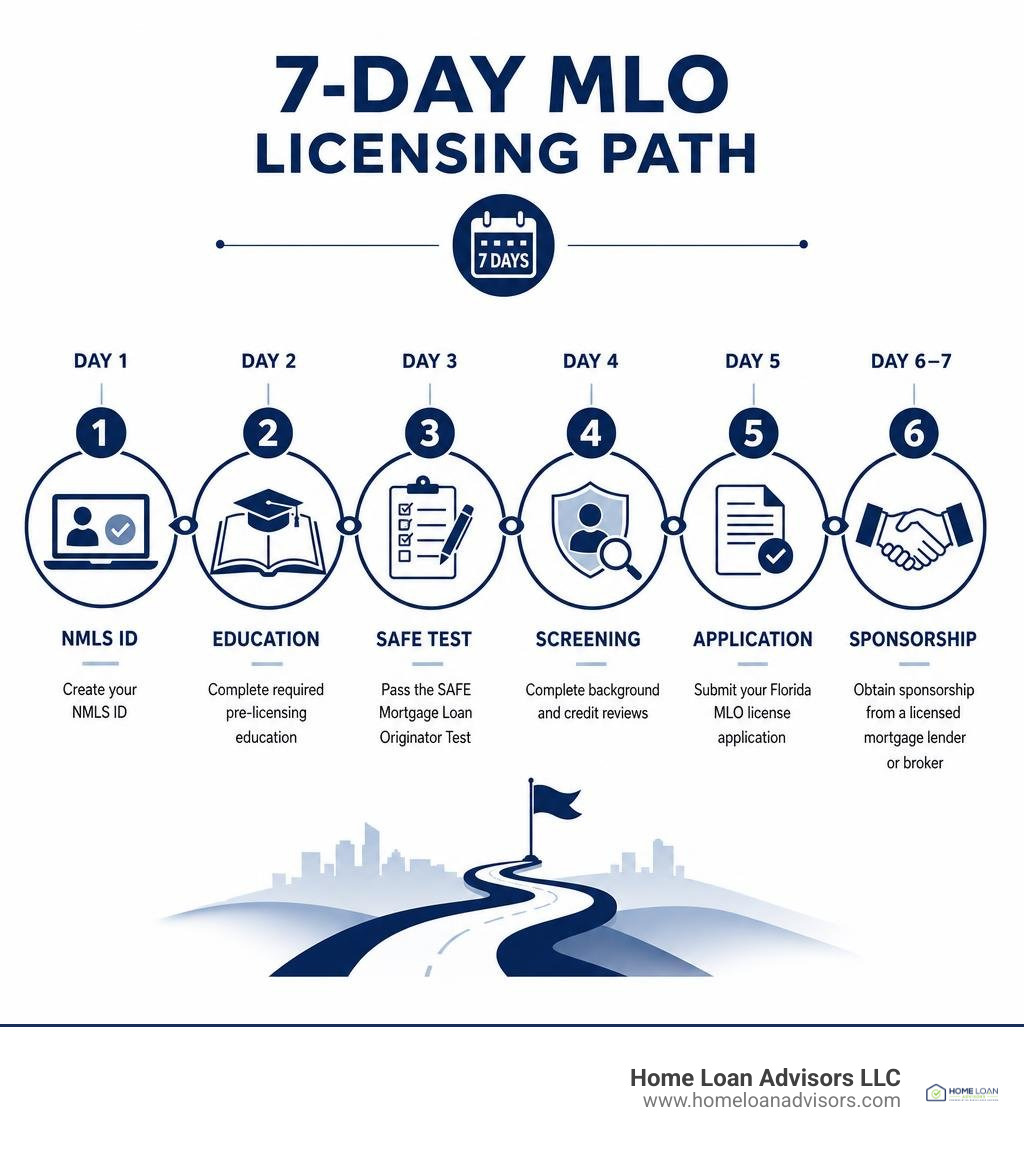
Step-by-Step Roadmap: How to Become a Loan Officer
Getting into the mortgage business requires clearing specific legal and educational milestones. In August 2026, the licensing structure remains strictly regulated under federal and state frameworks designed to protect consumers. While your practical prep work can happen during an intensive week, state processing and exam availability set the actual tempo.
Here is the exact progression from start to finish:

Educational and Background Prerequisites: How to Become a Loan Officer

Before you buy courses or register for testing, you need to understand the baseline entry requirements.
- Age and Basic Education: You must be at least 18 years old and hold a high school diploma or GED. A four-year college degree in finance, economics, or business is helpful for personal development, but regulators do not require one.
- NMLS Account Creation: You must register on the Nationwide Multistate Licensing System (NMLS) website to receive your Unique Identifier (NMLS ID). This number stays with you throughout your entire career.
- Character and Financial Responsibility: State regulators review your personal credit history. You do not need a perfect credit score, but regulators look for patterns of financial neglect, open tax liens, or unpaid civil judgments.
- Criminal History Standards: Under the SAFE Act, felony convictions involving fraud, dishonesty, breach of trust, or money laundering permanently disqualify an applicant. Other felony convictions within the preceding seven-year period can also prevent licensure.
20-Hour NMLS Pre-Licensing Education and Coursework
Federal law requires a minimum baseline of 20 hours of NMLS-approved pre-licensing education. If you choose an intensive full-time schedule, you can complete these hours over several consecutive days.
The standard national curriculum breaks down into core topics:
- Federal Law and Regulations (3 Hours): Covers consumer protection statutes like the Truth in Lending Act (TILA), Real Estate Settlement Procedures Act (RESPA), Equal Credit Opportunity Act (ECOA), and Home Mortgage Disclosure Act (HMDA).
- Ethics and Consumer Protection (3 Hours): Covers fair lending, fraud prevention, consumer privacy, and professional standards.
- Non-Traditional Mortgage Guidance (2 Hours): Focuses on adjustable-rate mortgages, interest-only structures, and specialized products.
- Electives and General Mortgage Knowledge (12 Hours): Covers loan origination principles, financial calculations, loan-to-value (LTV) limits, and debt-to-income (DTI) formulas.
Candidates preparing for their state credentials often choose to Become a Licensed Mortgage Loan Originator (MLO) through accredited course providers who report completed hours directly to the NMLS database.
Passing the SAFE Mortgage Loan Originator National Exam
Once your education is logged, you must sit for the National Test with Uniform State Content, administered through Prometric testing centers or approved online proctoring.
- Format: 120 multiple-choice questions (115 scored, 5 unscored trial questions).
- Time Limit: 190 minutes.
- Passing Threshold: A score of 75% or greater is required to pass.
- Cost:$110 per attempt.
Data shows the national first-time pass rate sits around 55%. The exam is notoriously detail-heavy, focusing on exact regulatory disclosure timeframes, calculation formulas, and compliance penalties. Setting aside dedicated time for practice exams and flashcards before booking your seat makes a significant difference.
State Licensing and Florida Regulations: How to Become a Loan Officer
Mortgage originators who work in Florida are regulated directly by the state. Individual licensing is handled through the Loan Originator division of the Florida Office of Financial Regulation (OFR).
While some states require additional state-specific pre-licensing hours—Texas requires 23 hours total, for instance—Florida uses the standard 20-hour SAFE curriculum. If you plan to serve clients across multiple states, such as expanding from Florida into Wisconsin or neighboring markets, you must verify if those additional jurisdictions require extra state-law modules before submitting your applications.
Submitting Form MU4, Background Checks, and Employer Sponsorship
Passing your exam qualifies you to apply, but it does not let you originate loans on its own.
You must log into the NMLS portal to complete the following steps:
- Filing Form MU4: Submit the Uniform Individual Mortgage License/Registration Application detailing your residential, employment, and personal history.
- Background Screening: Schedule an appointment with an authorized vendor such as IdentoGO for electronic fingerprinting ($36.25 FBI fee) and authorize an NMLS credit check ($15).
- State Filing Fees: Pay the state application and investigation fees, which vary by jurisdiction.
- Securing Employer Sponsorship: Your state license remains in an "inactive" status until a licensed mortgage broker or direct lender submits an electronic sponsorship request confirming your employment.
Understanding whether you want to work under an independent advisor vs broker model or a retail banking environment helps determine which sponsoring firm aligns best with your career goals.
Core Skills, Compensation, and Career Outlook for Loan Officers
Entering the mortgage profession gives you independence, but long-term success requires blending analytical precision with clear, steady customer communication.
Essential Soft Skills and Financial Analysis Competencies
Originating loans involves far more than taking applications. You have to interpret complex guidelines and structure files so that loans move through underwriting smoothly.
Key competencies you will build include:
- Financial Calculations: Accurately calculating complex debt-to-income ratios, identifying usable self-employment income, and evaluating asset liquidity.
- Software Fluency: Navigating modern Loan Origination Systems (LOS) and automated underwriting software.
- Problem-Solving: Identifying solutions for property appraisal conditions, title requirements, or credit challenges.
- Clear Communication: Explaining underwriting conditions to buyers in simple, understandable terms without industry jargon.
Salary Expectations and Industry Job Growth
According to the Loan Officers : Occupational Outlook Handbook: : U.S. Bureau of Labor Statistics, the median annual wage for loan officers was $74,180 in May 2024. Earnings vary widely based on production, experience, and lending structure:
| Metric / Category | Industry Statistics (U.S. BLS) |
|---|---|
| Median Annual Wage | $74,180 |
| Lowest 10% Earners | Less than $38,490 |
| Highest 10% Earners | More than $145,780 |
| Total Jobs (2024) | 301,400 positions |
| Projected Job Growth (2024–2034) | 2% (approx. 20,300 annual openings) |
| Top Employing Industry | Credit Intermediation (79% of all loan officers) |
Employment is projected to grow 2 percent through 2034, which is slower than average due to branch consolidation and technology. However, about 20,300 openings are projected each year on average across the decade, primarily to replace professionals who retire or change careers.
Launching Your Career: Building a Referral Network in Tampa Bay

Getting licensed takes study, but building a sustainable pipeline takes consistent relationship building. In local markets across Tampa, St. Petersburg, and Clearwater, personal trust drives purchase transactions.
Partnering with Real Estate Agents and Industry Professionals
Purchase business relies on solid professional relationships. Real estate agents, financial planners, divorce attorneys, and certified public accountants regularly work with clients who need clear lending guidance.
When you offer a reliable mortgage advisory service, your role is to deliver smooth transactions, clear communication, and dependable closings. Visiting open houses, attending local real estate associations, and providing helpful educational updates on lending guidelines establishes your presence in the market.
Maintaining Compliance and Annual Continuing Education
Your license is not permanent once issued. Under NMLS rules, all state-licensed loan originators must complete continuing education (CE) annually and renew their license by December 31.
The standard annual CE requirement involves at least 8 hours of coursework:
- 3 hours of Federal Law
- 2 hours of Ethics and Fair Lending
- 2 hours of Non-Traditional Mortgage Lending
- 1 hour of Elective Coursework
Failing to complete your CE before state renewal deadlines can place your license into an inactive status, preventing you from originating until you complete late-CE courses and pay reinstatement fees.
Frequently Asked Questions About Becoming a Loan Officer
Can I become a mortgage loan officer with no experience?
Yes. Many people enter mortgage origination with backgrounds in retail sales, hospitality, customer service, or banking. A common entry path is starting as a loan officer assistant (LOA) or junior processor. This lets you learn loan origination systems, packaging guidelines, and document collection workflows while completing your licensing exams.
What happens if I fail the SAFE MLO exam?
If you do not pass on your first attempt, NMLS guidelines enforce specific retake windows:
- You must wait 30 days before taking the exam a second time.
- If you fail the second attempt, you must wait another 30 days for your third attempt.
- If you do not pass on the third attempt, you must wait a mandatory 180 days (6 months) before testing again.
Each test attempt requires paying the $110 registration fee.
Do loan officers work on commission or salary?
Compensation structures depend on your employer. Depository banks and credit unions often offer a base salary combined with modest volume bonuses. Independent mortgage brokerages and non-depository lenders typically use commission-based models or draw-against-commission structures. Commission splits generally pay a set number of basis points based on funded loan volume.
Conclusion
Becoming a mortgage professional provides an opportunity to build a long-term business while helping individuals and families navigate one of the largest financial transactions of their lives. While passing the SAFE exam and submitting your state application requires focused effort, the foundational knowledge you gain sets the stage for a rewarding career across Florida and beyond.
If you have questions about the mortgage process or want to explore home financing options, visit Home Loan Advisors to learn more about how we help buyers navigate the lending journey.
Mortgages are complex so let me give you the tools you need to make the right decisions.