Step-by-Step Guide to Comparing 15-Year Home Equity Loans
Understanding the 15 Year Home Equity Loan Structure
A 15-year fixed home equity loan acts as a standalone second mortgage that sits behind your primary loan. Instead of replacing your existing first mortgage, it lets you access a one-time lump sum of cash while keeping your original loan terms intact.
The structure is straightforward: you repay the balance in 180 equal monthly installments at a fixed interest rate. Because the rate remains consistent throughout the life of the loan, your principal and interest payment does not change. This setup appeals to borrowers who prefer predictable budgeting over the fluctuating monthly payments common with variable-rate lines of credit.
Federal consumer protections require lenders to provide clear disclosures outlining how your loan balance, interest, and payments work over time, as highlighted in the Federal Reserve home equity model disclosures. If you want to explore how subordinate liens work alongside primary mortgages, reviewing general Home Equity Loan Information can help clarify the broader lending guidelines.
Calculating Payments on a 15 Year Home Equity Loan
Because a 15-year equity loan amortizes over 180 months rather than 360 months, the pace of your principal reduction is significantly faster than a traditional long-term loan.
During the initial years of any amortized loan, a larger portion of each payment goes toward interest charges. However, on a 15-year schedule, the tipping point where your payment reduces more principal than interest arrives much earlier—often within the first several years of repayment. As your loan balance increases, your required monthly payment scales accordingly, while the 15-year fixed timeframe keeps your ultimate payoff date locked in. To see how different balances change your monthly obligation, you can run numbers using our Mortgage Calculator.
Qualification Criteria and Borrowing Limits
(Note: Specific guidelines for Conventional, FHA, VA, or USDA financing are subject to formal compliance review and individual underwriting assessment.)
Qualifying for a fixed-rate second mortgage involves evaluating four primary factors:
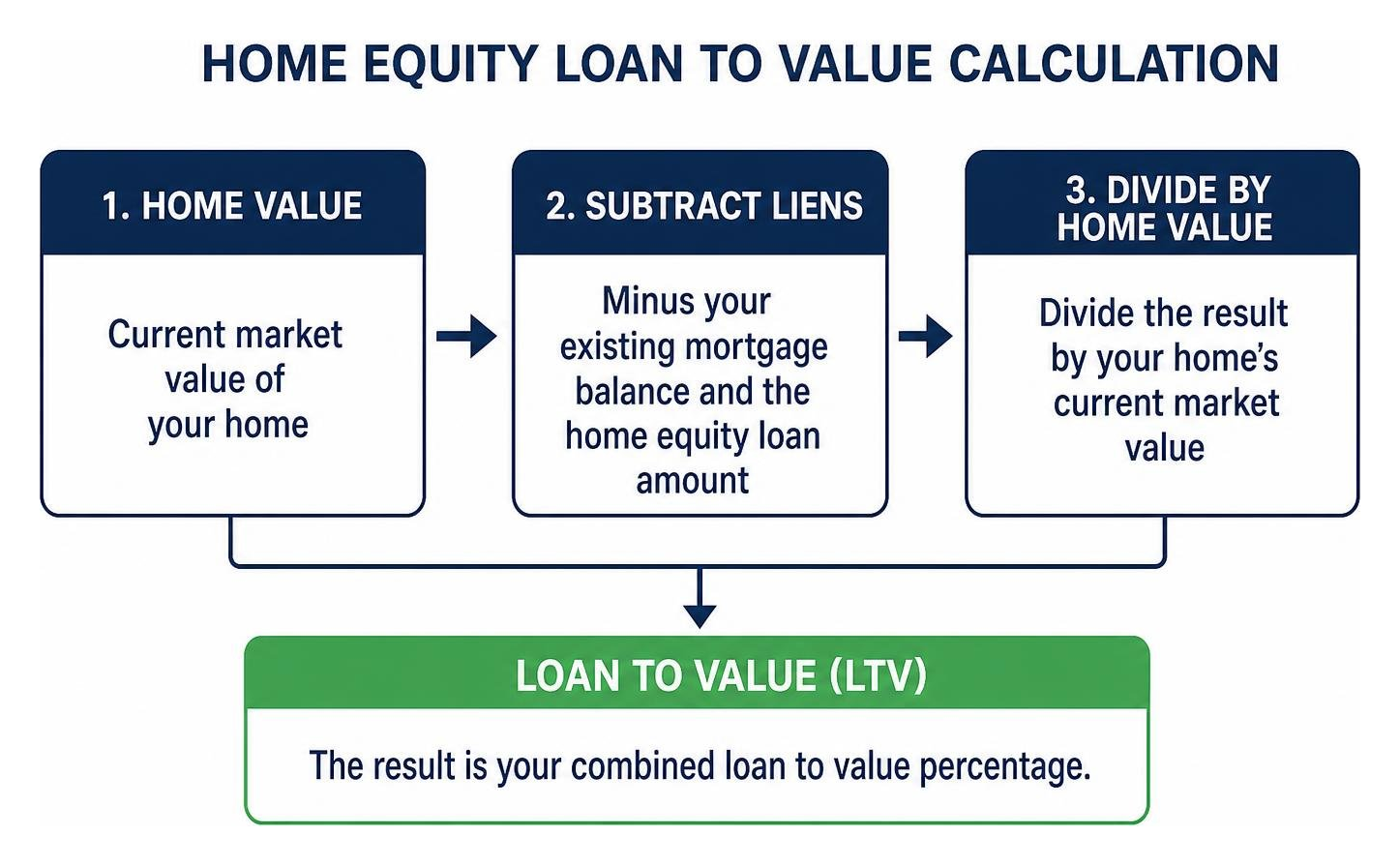
- Combined Loan-to-Value (CLTV): Lenders look at the total balance of all mortgages against your property's appraised value. While some credit unions and specialized programs allow up to 90% CLTV, many institutional lenders set standard limits between 80% and 85%. For example, on a home valued at $500,000 with an existing $230,000 first mortgage, an 80% CLTV cap allows total financing of up to $400,000, leaving up to $170,000 in potential borrowing capacity.
- Credit Score: While baseline approval thresholds generally start around 620 to 640, securing the most competitive terms typically requires a credit score of 720 or higher.
- Debt-to-Income (DTI) Ratio: Most programs look for a total DTI ratio—including your primary mortgage, new equity loan, and recurring consumer debts—below 43% to 50% of your gross monthly income.
- Closing Costs and Valuation: Closing costs on a home equity loan generally range from 2% to 5% of the loan amount, covering property valuation fees, title search expenses, and origination charges. In Florida markets like Tampa Bay, local property appraisals must also account for current flood zone designations and property condition requirements.
Comparing 15-Year Terms Against Other Equity Options
Choosing the right repayment duration requires balancing monthly cash flow flexibility against long-term interest expense.
A 10-year loan offers rapid debt payoff and the lowest total interest, but requires a higher monthly commitment. A 20-year or 30-year term lowers your required monthly outlay, but spreads interest accumulation over an extended window.
Here is how key loan terms compare across structure and cost tradeoffs:
| Loan Term | Monthly Payment Impact | Total Interest Cost | Payoff Timeline |
|---|---|---|---|
| 10-Year Fixed | Highest monthly payment | Lowest lifetime interest expense | 120 months |
| 15-Year Fixed | Balanced monthly payment | Substantial interest savings vs. longer terms | 180 months |
| 20-Year Fixed | Lower monthly payment | Higher overall lifetime interest charges | 240 months |
Choosing a 15-year term strikes a practical balance: it lowers the monthly obligation compared to an aggressive 10-year schedule while avoiding the significant cumulative interest of a 20-year term. Shortening your repayment schedule accelerates equity accumulation, whereas extending the timeline preserves month-to-month cash flow at the cost of higher overall borrowing expenses. You can explore deeper comparative mortgage math on payoff timelines through this breakdown of comparative mortgage amortization math.
15-Year Fixed Loan vs. HELOC
A 15-year fixed-rate home equity loan provides a single lump sum with identical monthly payments throughout its life.
In contrast, a Home Equity Line of Credit (HELOC) functions as a revolving credit account, often structured with a 10-year draw period followed by a 5-year repayment phase. During the draw period, borrowers often make interest-only payments on variable rates tied to benchmark indices like the Prime Rate.
If you have a one-time, fixed-cost project—such as a roof replacement or whole-home window upgrade—a fixed 15-year loan provides cost certainty. If your expenses are phased over several years, a HELOC offers draw-as-you-go flexibility, though it carries the risk of rising monthly payments if benchmark rates climb.
Cash-Out Refinance vs. Second Mortgage
A cash-out refinance replaces your existing primary mortgage entirely with a new, larger loan. A 15-year home equity loan, on the other hand, leaves your original mortgage untouched and adds a second lien.
If you previously locked in a historically low primary mortgage rate, replacing that entire balance through a cash-out refinance may not make financial sense. Adding a standalone 15-year second mortgage lets you access necessary funds without disturbing the favorable pricing on your first lien. If you want to evaluate whether replacing your entire primary loan makes sense under current market conditions, you can review our Refinance options.
Practical Applications for Tampa Bay Homeowners
Homeowners across Tampa, St. Petersburg, Clearwater, and surrounding Gulf Coast communities have seen significant property appreciation over recent years. A 15-year equity loan offers a structured path to put that accumulated value to work for specific financial objectives:
- Substantial Home Improvements: Financing structural upgrades, hurricane-rated impact windows, modernized HVAC systems, or kitchen renovations that directly protect or enhance property value.
- Consolidating High-Interest Debt: Replacing variable, double-digit consumer debt with a single, predictable monthly payment backed by a clear 15-year payoff date.
- Insurance and Escrow Management: In coastal Florida, budgeting for property taxes and hazard/flood insurance requires careful cash-flow planning. A fixed second mortgage ensures your core debt obligation remains steady regardless of external economic shifts.
Is a 15 Year Home Equity Loan Right for Your Financial Goals?
A 15-year term is often well-suited for mid-career professionals and pre-retirees who want to eliminate secondary debt before transitioning to a fixed retirement income. It provides a disciplined framework that builds equity twice as fast as a traditional 30-year amortization schedule without imposing the aggressive monthly payments of a 5- or 10-year loan.
However, because the loan uses your residential property as collateral, failure to meet repayment terms creates real foreclosure risk. It is critical to ensure that the required payment fits comfortably within your monthly budget even if household income fluctuates.
Frequently Asked Questions about 15-Year Home Equity Financing
Can I pay off a 15-year home equity loan early without prepayment penalties?
In most cases, borrowers can make extra principal payments or pay off their balance ahead of schedule without penalties. However, terms vary by lender, and some institutions may assess an early closure fee if the account is paid off within the first 24 to 36 months. Be sure to review the promissory note to confirm prepayment terms before closing.
What happens to my home equity loan if property values fluctuate?
Your fixed interest rate and required monthly payment remain identical regardless of whether local real estate prices rise or fall. However, if market values decline significantly, your total loan balances could exceed the market value of your property, reducing your ability to sell or refinance until additional principal is paid down.
How does a 15-year term affect overall interest compared to longer loans?
A 15-year term drastically reduces lifetime interest charges compared to 20- or 30-year structures. By compressing amortization into 180 months, a larger percentage of every payment immediately chips away at the principal balance, saving tens of thousands of dollars in cumulative interest over the loan duration.
Conclusion
Navigating secondary financing requires looking beyond basic advertised rates to evaluate how repayment terms, closing fees, and monthly obligations align with your long-term wealth strategy. Whether you are considering a second mortgage or looking at a full 15 Year Fixed Mortgage replacement, having transparent, local guidance ensures you choose the right path for your household.
If you are evaluating equity options in Tampa, St. Petersburg, Clearwater, or across Florida and Wisconsin, I invite you to reach out so we can discuss the numbers and see what makes sense for your specific situation.