
A Comprehensive Guide to Finding a Trusted Mortgage Advisor
What Are Professional Mortgage Advisors and How Do They Differ From Banks?
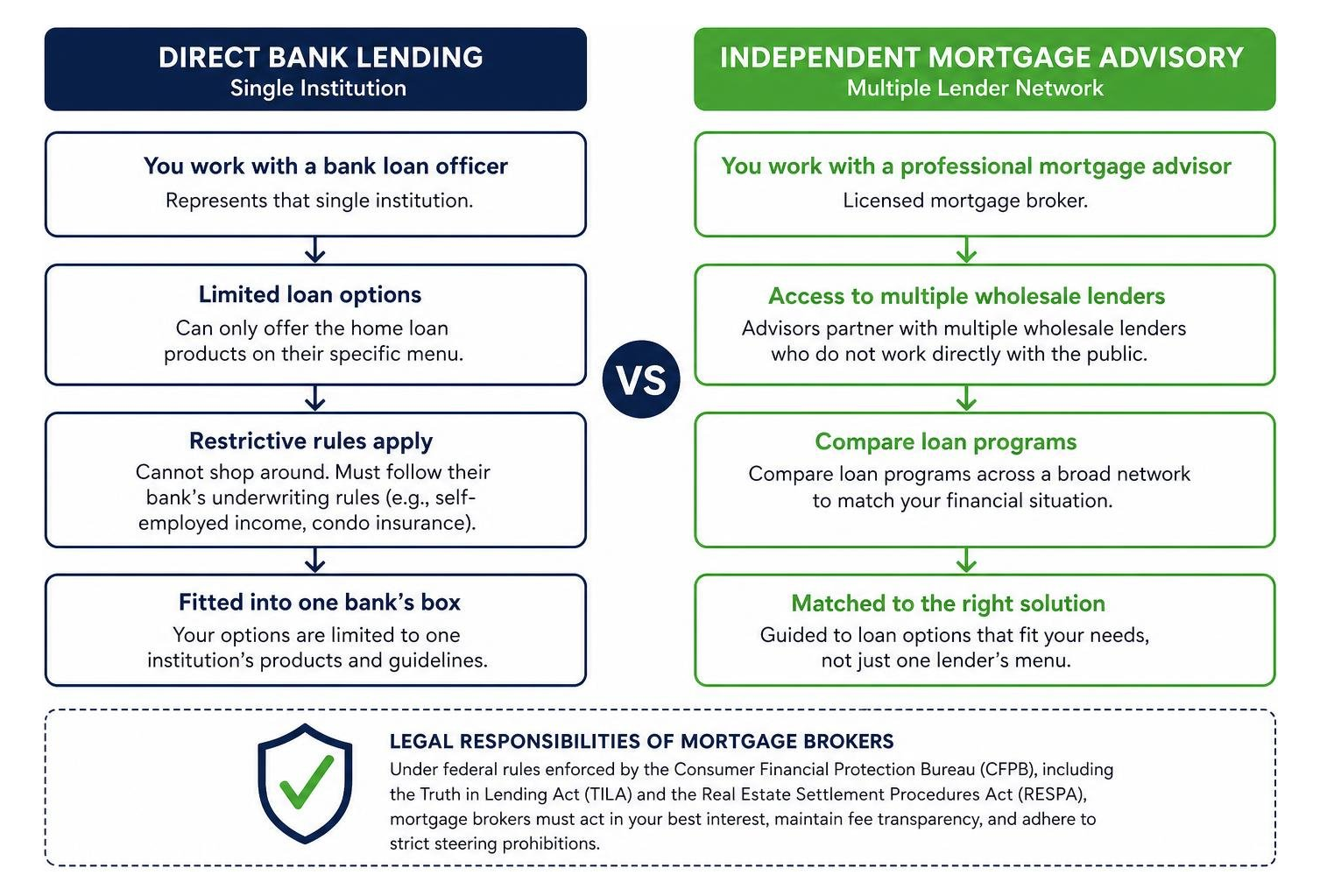
When you walk into a retail bank in Tampa, the loan officer behind the desk represents that single institution. They can only offer you the home loan products on their specific menu. If their bank has strict underwriting rules for self-employed income or high condo insurance adjustments in Pinellas County, that loan officer cannot shop around for you.
Independent professional mortgage advisors work differently. As licensed mortgage brokers, we partner with multiple wholesale lenders. Wholesale lenders do not work directly with the public; instead, they operate through independent mortgage professionals. This structure allows an advisor to compare loan programs across a broad network to match your financial situation, rather than fitting you into a single bank's box.
Under federal rules enforced by the Consumer Financial Protection Bureau (CFPB), including the Truth in Lending Act (TILA) and the Real Estate Settlement Procedures Act (RESPA), mortgage brokers have clear legal responsibilities to borrowers. Brokers must act in your best interest, maintain fee transparency, and adhere to strict steering prohibitions.
Key Qualifications of Professional Mortgage Advisors
Not all individuals offering financial guidance hold the credentials required to originate home loans. In the United States, professional mortgage advisors must maintain an active license through the Nationwide Mortgage Licensing System (NMLS).
When evaluating an advisor, check for these fundamental credentials:
- NMLS Registration: Verify their license number on the official NMLS Consumer Access website.
- Industry Experience: Look for an advisor with several years in financial services. Experienced brokers have managed varying rate environments and complex underwriting scenarios.
- Continuing Education: State and federal guidelines require annual continuing education to keep originators updated on tax laws, lending guidelines, and consumer protection mandates.
- Specialized Knowledge: Overseas qualifications like the UK's CeMAP (Certificate in Mortgage Advice and Practice) reflect rigorous training abroad, while U.S. advisors demonstrate expertise through state-specific licensing and specialized product certifications.
Advisor vs. Loan Officer vs. Mortgage Broker
Understanding the titles used in home financing helps you evaluate your options:
| Role | Employer | Product Access | Key Characteristic |
|---|---|---|---|
| Bank Loan Officer | Single retail bank or credit union | Only internal bank products | Represents the lending institution; bound by employer options. |
| Mortgage Broker / Advisor | Independent brokerage firm | Multiple wholesale lenders | Independent intermediary; shops the market for loan options tailored to your profile. |
| Loan Originator | Generic industry term for license holder | Varies by employment structure | The legal classification for anyone licensed to take mortgage applications. |
Working with an independent advisor allows you to evaluate multiple interest rate lock structures, float-down options, and closing cost options through a single point of contact.
How Professional Mortgage Advisors Assist Complex Borrowers and Special Scenarios
A straightforward loan application with W-2 income and a standard down payment is relatively simple. However, many home buyers in Tampa Bay face more complex financial scenarios.
How Professional Mortgage Advisors Serve Diverse Buyer Needs
Different buyer profiles require distinct loan structures:
- First-Time Buyers: Need education on true out-of-pocket costs, escrow setup for Florida property taxes, and home insurance requirements.
- Self-Employed Individuals: Require specialized income analysis, as tax write-offs may reduce net income on standard tax returns.
- Foreign Nationals & Expats: Need help navigating visa requirements, foreign asset transfers, and establishing credit in the U.S. financial system.
- Move-Up Buyers in Tampa Bay: Need assistance coordinating the purchase of a new home in areas like South Tampa or St. Petersburg while managing the sale of their current residence.
- Real Estate Investors: Require analysis of rental cash flow, short-term vs. long-term lease rules, and portfolio financing strategies.
Navigating Irregular Income, Credit Challenges, and Cross-Border Purchases
When traditional bank underwriting automated systems turn down an applicant, an independent advisor can explore alternative underwriting paths.
For self-employed business owners, options like bank statement loan programs evaluate overall cash flow rather than net taxable income on tax returns. Borrowers managing past credit disruptions can work with an advisor to understand how timing, manual underwriting, and credit rebuilding strategies impact borrowing options.
Foreign buyers purchasing property in Florida must navigate specific verification steps, including international asset verification, passport and visa documentation, and international wire rules. Knowing How to Find the Right Loan Officer who understands these unique underwriting requirements can help avoid delays during escrow.
Fee Structures, Compensation, and Best Interest Standards
Understanding how a mortgage advisor gets paid is essential for clear collaboration. Federal law dictates how brokers can be compensated to prevent conflicts of interest.

Mortgage broker compensation typically follows one of two structures:
- Lender-Paid Compensation: The wholesale lender pays the broker a fee upon successful closing. In most scenarios, this means you do not pay your broker out-of-pocket for their advisory services.
- Borrower-Paid Compensation: The borrower pays the advisory fee directly, which is itemized on the official Loan Estimate and Closing Disclosure documents.
Federal law caps mortgage broker compensation at 3 percent of the loan principal. Furthermore, regulations strictly forbid linking a broker's compensation to the interest rate on the loan. A broker cannot charge you more money simply by placing you in a higher interest rate.
Under federal rules, brokers are legally bound to act in the borrower's best financial interest. They cannot steer you toward a specific lender or loan product to earn higher compensation.
Key Benefits of Working With an Advisor Versus a Direct Lender
Applying directly with a bank means submitting your information to one system. If that lender changes its underwriting criteria or shifts pricing, your options are limited.
Working with an independent mortgage advisor provides several distinct advantages:
- Broader Market Access: Access to wholesale pricing and specialized loan programs across dozens of wholesale lenders.
- Tailored Financial Education: Instead of receiving a standard pre-approval form, you learn how debt-to-income ratios, interest rate structures, and loan types fit your budget.
- Streamlined Processing: Independent brokerages often use dedicated processing teams to handle documentation efficiently, keeping your application moving forward.
- Local Market Insights: In areas like Tampa, St. Petersburg, and Clearwater, local knowledge matters. Factors like flood zones, condo structural reserves, and local property insurance requirements impact loan approval.
- Ongoing Rate Monitoring: A dedicated advisor keeps an eye on market trends to help you identify opportunistic timing for rate locks or future refinancing.
Check out our client Reviews to see how personalized loan guidance helps buyers across Florida and Wisconsin navigate financing with confidence.
Essential Questions to Ask When Interviewing Potential Advisors
Before committing to a mortgage advisor, interview them to ensure their communication style and operational setup match your expectations.
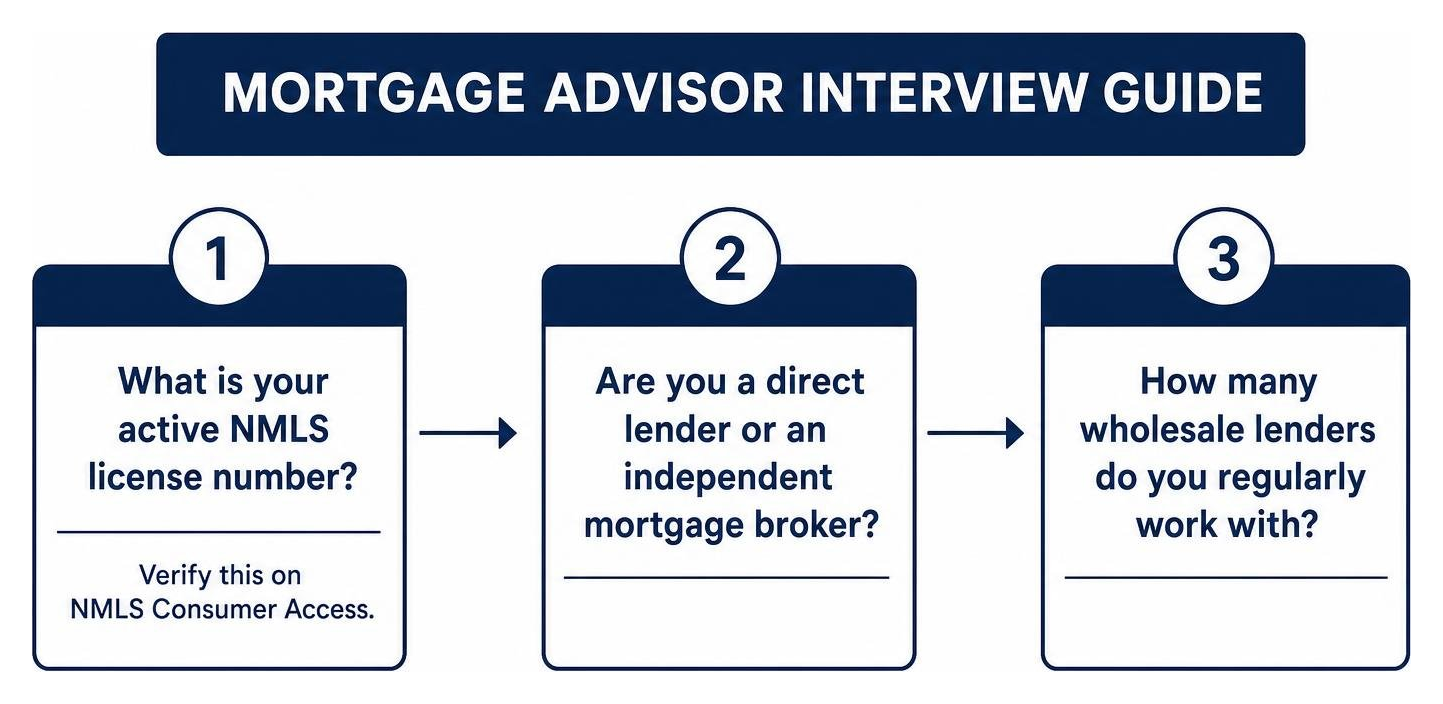
Consider asking these key questions:
- What is your active NMLS license number? (Verify this on NMLS Consumer Access).
- Are you a direct lender or an independent mortgage broker?
- How many wholesale lenders do you regularly work with?
- How are your advisory services compensated, and will I owe any out-of-pocket broker fees?
- What is your process for managing rate locks and float-down options if market conditions change?
- How do you handle complex financial profiles like self-employment income or past credit hurdles?
- What is your typical communication cadence once an offer is accepted?
Ready to look at potential financing scenarios for your next purchase? You can request a fast Get a Quote online, or reach out directly through our Contact page to start a conversation.
Frequently Asked Questions About Home Loan Guidance
Do mortgage advisors charge upfront out-of-pocket fees to borrowers?
In most standard residential mortgage transactions, mortgage advisors do not charge upfront out-of-pocket fees to borrowers. Broker compensation is generally paid by the wholesale lender upon successful loan closing, or included as an itemized cost within the standard closing disclosures. Third-party costs—such as home appraisals or credit report fees—are paid directly to those service providers.
Can a mortgage advisor help if I have self-employment income or lower credit scores?
Yes. Independent advisors work with wholesale lenders offering alternative documentation options, such as bank statement programs for self-employed applicants. They can also review manual underwriting options for borrowers working to rebuild their credit profiles.
How does pre-qualification differ from full pre-approval with an advisor?
A pre-qualification is an initial, unverified estimate of borrowing potential based on self-reported financial details. A full pre-approval involves verifying income documents, tax returns, bank statements, and credit files. A pre-approval provides a clearer picture of your purchasing power when submitting offers in competitive markets like Tampa Bay.
Navigating Your Home Loan Options with Confidence
Finding the right home financing solution comes down to education, transparency, and personal fit. An independent mortgage professional helps you evaluate loan structures, navigate changing regulations, and find a mortgage option aligned with your long-term goals.
At Home Loan Advisors, led by Vice President Josh Jampedro (NMLS #1082889), we focus on an educated approach to modern mortgage lending. Serving clients across Florida and Wisconsin, we provide clear communication, transparent pricing, and personalized support from application to closing.
Learn more about our team on our About Us page, check out details on our leadership via About CEO, or visit Home Loan Advisors to explore your financing options.
Home Loan Advisors is an Equal Housing Lender. NMLS #1082889. Specific loan options, including FHA, VA, USDA, and Conventional programs, are subject to individual eligibility and underwriting guidelines.
Mortgages are complex so let me give you the tools you need to make the right decisions.