
Brokers and Advisors Demystified to Save Your Wallet
When navigating the financial world, understanding the distinction between an advisor vs broker starts with the legal rules governing their behavior. While both professionals assist you with your finances, they operate under fundamentally different regulatory frameworks that directly impact the advice you receive.
An investment adviser is governed by the Investment Advisers Act of 1940 and is legally classified as a fiduciary. This legal standard mandates a continuous duty of loyalty and care. In simple terms, an adviser must place your financial interests above their own at all times, actively avoiding or fully disclosing any conflicts of interest.
Conversely, brokers (and broker-dealer firms) are regulated under the Securities Exchange Act of 1934 and overseen by the Financial Industry Regulatory Authority (FINRA) alongside the Securities and Exchange Commission (SEC). Brokers are held to SEC Regulation Best Interest (Reg BI). Introduced to raise the bar above the historical "suitability standard," Reg BI requires brokers to act in their retail customers' best interest at the exact time a recommendation is made, without placing their firm's financial gain ahead of the client.
Understanding these legal frameworks is essential for evaluating your relationship with a financial expert. For a deeper breakdown of these regulatory boundaries, review the analysis on Fiduciary Advisor vs Broker: Key Differences - AdvoraHQ.
Duty of Care and Loyalty Obligations
The legal obligation owed to you depends heavily on whether you are working with a fiduciary adviser or a broker operating under Reg BI:
- Investment Advisers (Fiduciary Duty): Owes an ongoing duty of loyalty and duty of care. They must continually monitor your portfolio, seek to minimize investment costs, and eliminate or thoroughly disclose conflicts of interest.
- Brokers (Regulation Best Interest): Owes a duty of care, loyalty, disclosure, and conflict mitigation at the point of recommendation. However, this duty is episodic. A broker is not legally obligated to provide continuous monitoring of your account unless specifically agreed upon in writing.
Licensing and Regulatory Registration Requirements
The credentials held by financial professionals reflect their regulatory authority and allowable business practices:
- Series 7 (General Securities Representative Qualification Examination): Allows brokers to sell corporate securities, mutual funds, variable annuities, and municipal bonds. It requires firm sponsorship.
- Series 65 (Uniform Investment Adviser Law Examination): Qualifies individuals to act as investment adviser representatives and collect fee-based compensation for advice. It does not require firm sponsorship.
- Series 66 (Uniform Combined State Law Examination): Combines the material of the Series 63 and Series 65, allowing Series 7 holders to operate as fee-based advisers.
Advisers managing over $110 million in assets under management (AUM) must register directly with the SEC, whereas those managing smaller amounts register with state-level securities regulators. Brokers, meanwhile, must register with FINRA and the SEC regardless of portfolio size.
How Compensation Structures Impact Long-Term Growth
How your financial professional gets paid isn't just a minor detail—it can alter the long-term growth of your wealth. Industry data reveals that 87% of advisors report that at least half of their revenue is fee-based rather than commission-based. However, both payment structures carry unique traits you must evaluate.
To understand how fees translate into dollar amounts over a multi-decade investing timeline, consider this side-by-side comparison:
| Cost Element | Fee-Only Registered Investment Adviser (RIA) | Commission-Based Broker-Dealer |
|---|---|---|
| Primary Compensation | Percentage of Assets Under Management (AUM) | Upfront product sales loads, markups, and commissions |
| Typical Rates / Fees | 0.50% to 1.25% annually | 3.00% to 5.75% upfront loads + 0.25% to 1.00% ongoing trailing fees |
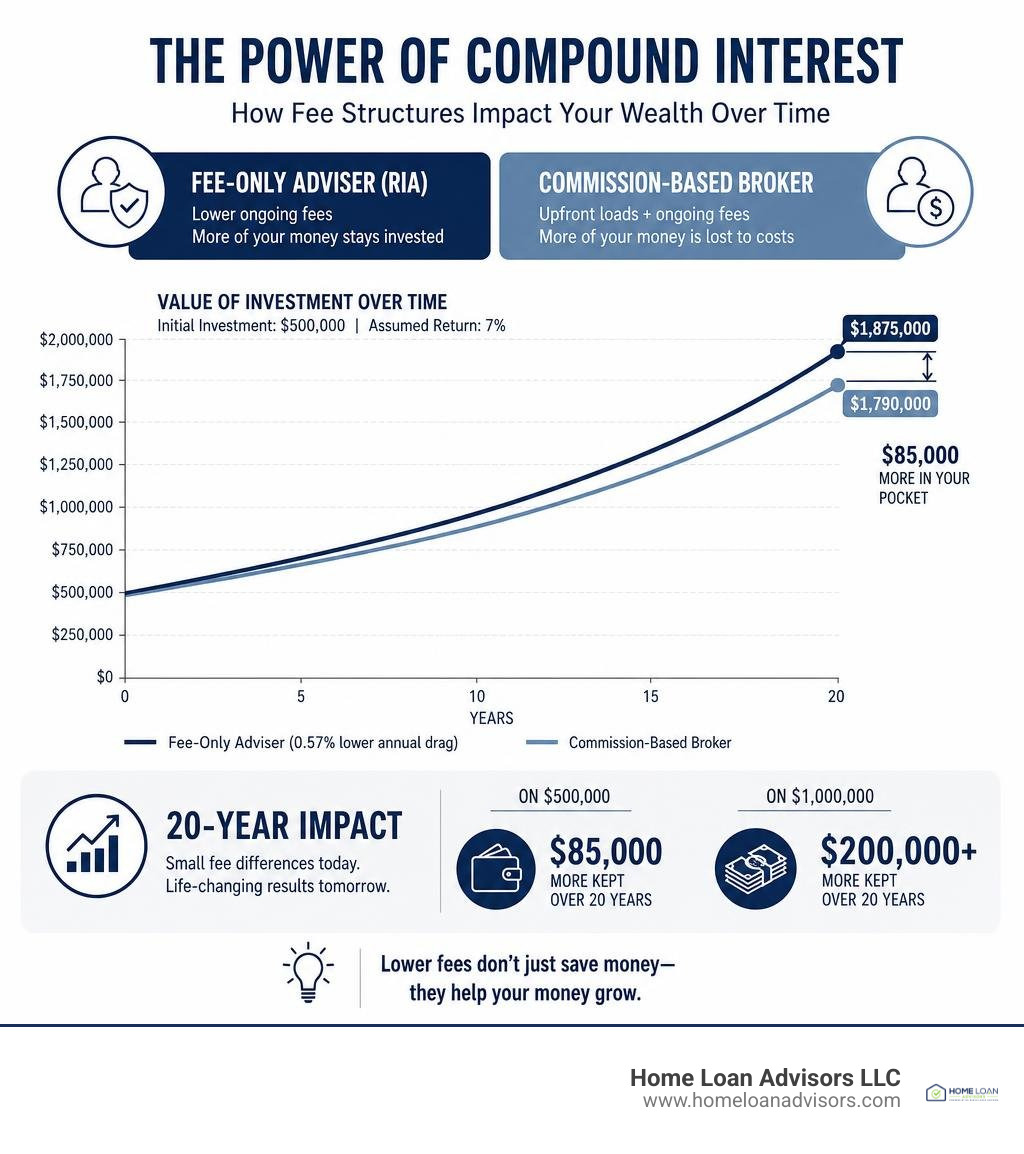
| 20-Year Growth on $500,000 (7% return) | Final balance reflects a modest 0.57% lower annual drag, keeping ~$85,000 more in growth | Upfront drag plus embedded product fees lower cumulative return |
| 20-Year Gap on $1,000,000 | Lower total cost structure preserves significant capital over time | Cumulative cost differences can exceed $200,000 over 20 years |
To explore how these fee models operate within independent firms, check out the detailed breakdown at RIA vs. Broker-Dealer: Fiduciary, Fees & Key Differences | 2026 | AdvisorGuide.
Evaluating Compensation Models in the Advisor vs Broker Dynamic
In the advisor vs broker context, compensation models fall into three main categories:
- Fee-Only: Advisers are paid directly by the client via hourly rates, flat retainers, or a fixed percentage of AUM (usually around 1%). They accept no commissions, product markups, or third-party kickbacks.
- Commission-Based: Brokers earn money when you buy or sell specific products. Compensation comes from transaction commissions, markups on bonds, mutual fund sales loads, or spreads.
- Fee-Based: A hybrid structure where a professional charges an AUM fee for account management but can also collect product commissions on transactions like annuities or insurance.
Small fee differences compound into massive sums over time. For example, over 20 years on a $500,000 investment, a modest 0.57% fee difference costs approximately $85,000 in lost portfolio growth. On a $1,000,000 portfolio, the cumulative cost difference between a fee-only RIA and a commission-based broker-dealer can exceed $200,000.
Conflicts of Interest and Revenue Sharing Scenarios
Commission structures can create inherent conflicts of interest. When a professional earns money only when a trade occurs or when a specific product is selected, there is a natural incentive to recommend higher-commission alternatives.
Common revenue-sharing scenarios include:
- Mutual Fund Sales Loads: Upfront fees (Class A shares) ranging from 3% to 5.75% that go directly to the selling broker.
- 12b-1 Marketing Fees: Annual distribution fees (0.25% to 1.00%) embedded inside mutual fund expense ratios paid out to the broker of record.
- Annuity Commissions: Complex variable or indexed annuities can pay upfront sales commissions exceeding 5% to 6% to the selling representative.
Services, Dual Registration, and Background Verification

While investment advisers handle overall asset allocation, rebalancing, tax-loss harvesting, and financial planning, brokers excel at executing specific trade orders and offering access to specialized financial products. However, the boundary between these roles often blurs due to dual registration.
If you are looking for trusted mortgage or lending guidance alongside your general financial strategy, learning How to Find the Right Loan Officer is a great starting point for securing transparent, education-focused assistance.
Understanding Dual-Registered Professionals
Roughly half of U.S. financial professionals who work with retail clients are dually registered. This means they are licensed as both an investment adviser representative and a broker-dealer agent.
While this allows a professional to offer a wider range of services under one roof, it creates potential confusion. A dually registered professional might wear an "adviser hat" while creating your financial plan (acting as a fiduciary) and switch to a "broker hat" when selling you a specific product (acting under Reg BI).
To bring clarity to these relationships, regulators require firms to provide Form CRS (Client Relationship Summary). Form CRS is a brief disclosure document outlining the firm's services, fees, conflicts of interest, standard of conduct, and disciplinary history.
How to Research Professional Disciplinary History
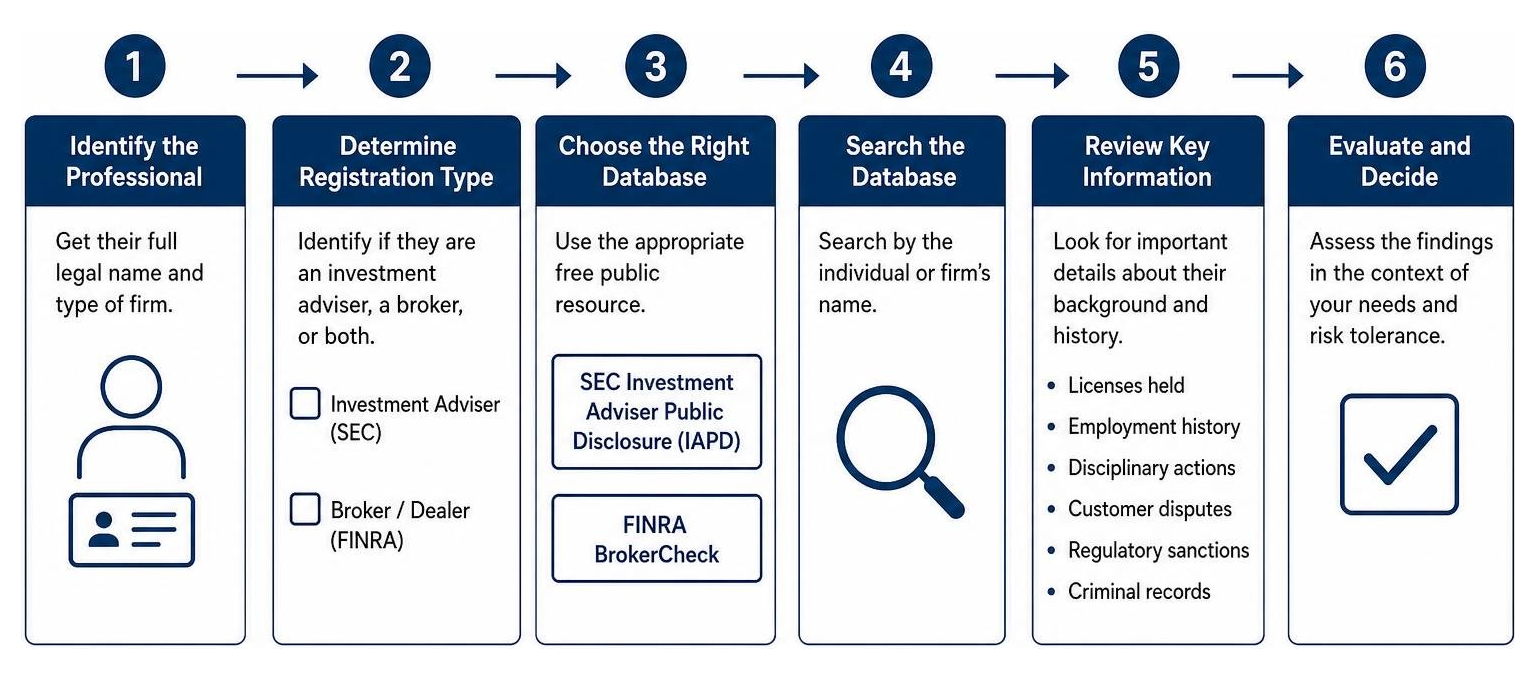
You should never hire a financial expert without checking their regulatory track record. Public, free lookup databases allow you to verify credentials and check for past disciplinary actions:
- FINRA BrokerCheck: Ideal for researching brokers and broker-dealer firms. It displays licenses held, employment history, customer disputes, regulatory sanctions, and criminal records.
- SEC Investment Adviser Public Disclosure (IAPD): The primary tool for researching investment advisers and RIAs. You can search by individual or firm name to view their Form ADV Part 1 and Part 2 disclosures.
Choosing the Right Financial Partner for Your Needs

Deciding whether you need an advisor or a broker depends entirely on your financial goals, technical knowledge, portfolio size, and desired level of involvement.
Selecting Advisor vs Broker Guidance Based on Your Goals
When deciding between an advisor vs broker, evaluate your primary needs:
- Choose a Broker if: You are largely a self-directed investor who wants to execute occasional single transactions, access specific corporate bond issuances or initial public offerings (IPOs), or purchase buy-and-hold products without paying an ongoing annual management fee.
- Choose an Investment Adviser if: You want continuous portfolio oversight, holistic estate and tax planning, systematic rebalancing, and a long-term strategy managed by a fiduciary who is legally required to put your interests first.
Matching Services to Investor Assets and Preferences
Portfolio size also influences your selection. Investment advisors typically have higher account minimums, often starting at $50,000 or more of investable assets, with specialized wealth management firms requiring minimums of $250,000 to $1,000,000.
If you are just beginning your investment journey with modest savings, a commission-based broker or a low-cost automated platform may be a more accessible entry point. However, as your net worth grows, the comprehensive, conflict-free advice of a fiduciary adviser often delivers greater value that outweighs the recurring fee.
Frequently Asked Questions
Can a financial professional be both an adviser and a broker?
Yes. Roughly half of retail financial professionals in the U.S. hold dual registrations. They can operate as fiduciary advisers when managing fee-based advisory accounts and act as brokers under Regulation Best Interest when executing specific product transactions. Always check your agreement to know which role they are fulfilling for a specific transaction.
How do I check if my advisor or broker has a disciplinary record?
You can search the SEC Investment Adviser Public Disclosure (IAPD) database for investment advisers or use FINRA BrokerCheck for brokers. Both tools are free and reveal registration details, customer complaints, regulatory enforcement actions, and employment histories.
What is the main cost difference between an advisor and a broker?
An investment adviser typically charges an ongoing fee based on a percentage of your managed assets (often around 1% AUM per year) or a flat/hourly fee. A broker earns transaction-based commissions, markups, or sales loads when investments are bought or sold. Over long horizons, recurring fees and product costs can compound significantly, making fee transparency vital.
Conclusion
Navigating the financial world becomes far simpler when you know how professionals are licensed, regulated, and compensated. Whether you are building an investment portfolio or purchasing a home, working with a team that values education, transparency, and tailored solutions is key to protecting your hard-earned wealth.
At Home Loan Advisors LLC, we bring that exact same education-driven mindset to mortgage lending. Operating out of Tampa, Florida, we combine clear communication with competitive financing options to help clients navigate every step of the mortgage process. Whether you need initial guidance or want to compare rate structures, we provide full support through pre-approval, underwriting, and closing.
Ready to take control of your financial future? Contact us today to learn more About Us, explore our transparent process, or Get a Quote on your next home loan with Home Loan Advisors.