How to Qualify for 100 Mortgages for First Time Buyers
Entering the housing market is a huge milestone, but gathering a five-figure cash sum for a down payment remains one of the largest obstacles for prospective homeowners. This is where 100 mortgages for first time buyers enter the equation.
A 100% mortgage allows you to borrow the complete purchase price of a property, eliminating the requirement to pay tens of thousands of dollars out of pocket upfront before receiving the keys.
How 100 Mortgages for First Time Buyers Work in 2026
In simple terms, loan-to-value (LTV) represents the percentage of the property's value that you are borrowing. If you buy a house for $270,000 using a standard loan, you might put down 5% ($13,500) and borrow 95% ($256,500). With a 100% LTV mortgage, the lender finances the entire $270,000, leaving you with a 0% initial equity stake.
These loans function similarly to standard mortgages in terms of payment mechanics—you make monthly principal and interest payments over an agreed term, such as 30 years. Most products start with a fixed-rate period (commonly 2 to 5 years) before transitioning to the lender's standard variable rate.
Recent financial innovations have also introduced "track record" mortgages. These specialized 100% loans do not require a cash deposit or family guarantor; instead, lenders evaluate your history of making full, on-time rent and utility payments over 12 consecutive months to assess your reliability.
To estimate what your monthly principal and interest obligations might look like under different financing amounts, try running your numbers through our Mortgage Calculator.
Eligibility Requirements for 100 Mortgages for First Time Buyers
Because the financial institution assumes all the asset risk by lending 100% of the property value, underwriting criteria are notoriously strict. To qualify, you generally must meet several baseline requirements:
- Affordability and Income Multipliers: Lenders impose firm debt-to-income (DTI) caps. They examine your total monthly obligations (car payments, student loans, credit cards) relative to your gross income to ensure your mortgage payment will not cause financial distress.
- Flawless Track Record: For zero-deposit loans that utilize rent tracking, you must present documented proof of paying rent on time for at least 12 straight months.
- Credit Score Standards: While standard loans might allow some historical credit hiccups, zero-deposit loans usually demand clean credit histories free from recent defaults or court judgments. Learn more about score thresholds in our guide on What Credit Score Do You Need for a Mortgage.
- Upfront Verification: Lenders will verify pay stubs, W-2s, and bank statements thoroughly before issuing a formal agreement.
Before house hunting, getting your documentation organized and applying for a verified Pre Approval gives you a realistic breakdown of your borrowing capacity.
Zero-Deposit Market Trends and Regional Demand

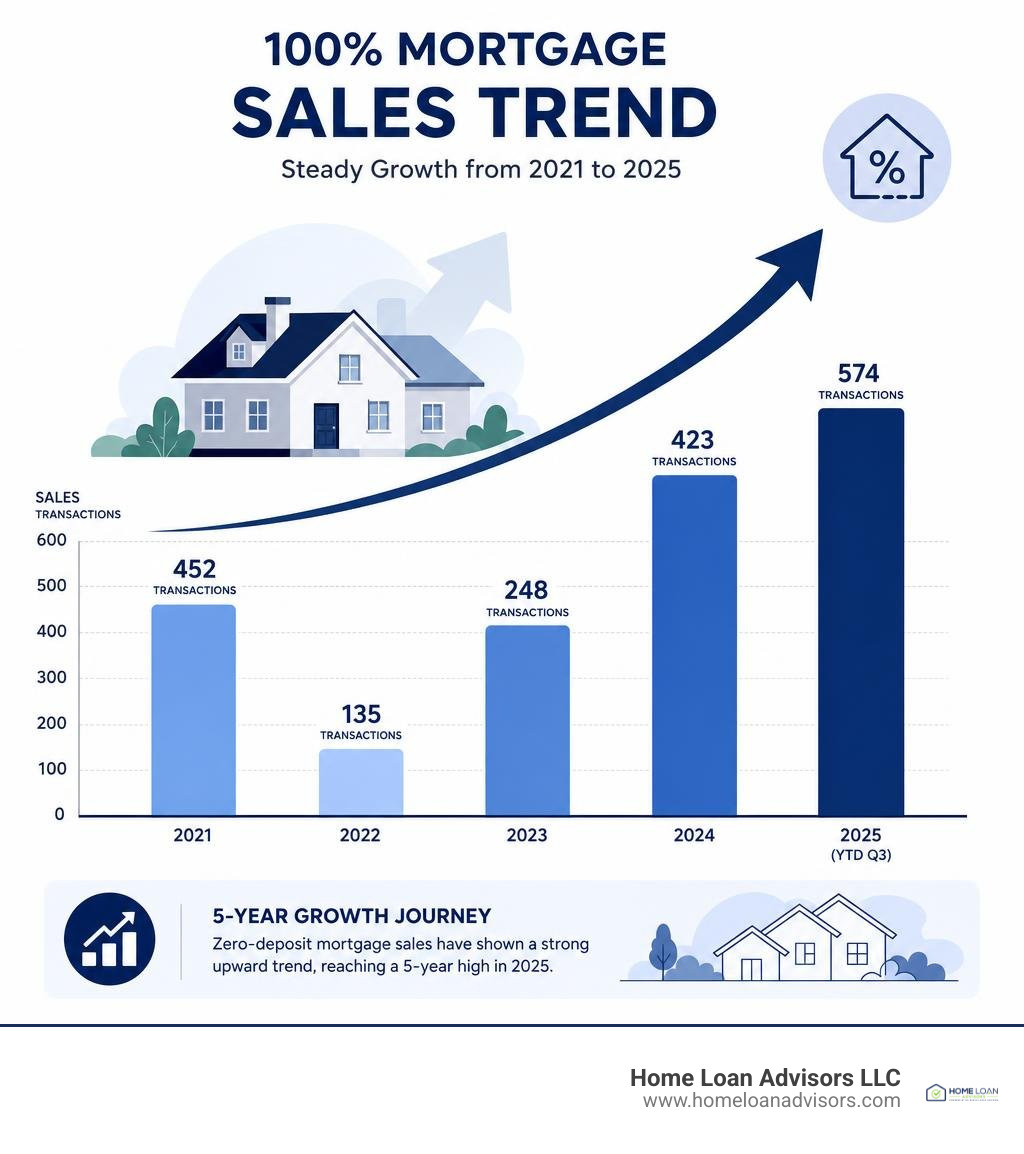
The market for zero-deposit and ultra-low-deposit home financing has seen notable swings over recent years. Following the economic uncertainty and mini-budget shocks of 2022—when zero-deposit sales plummeted to just 135 transactions nationwide—lenders have gradually expanded their risk tolerance to assist buyers struggling with high living costs and elevated rental rates.
Market Resurgence and Sales Growth
According to industry data published by Property Watchdog, sales of zero-deposit mortgages rebounded to 248 in 2023 and 423 in 2024. By the end of the third quarter of 2025, zero-deposit home purchases hit a five-year high of 574 transactions, surpassing the previous peak of 452 recorded in 2021.
This multi-year growth trend reflects both an appetite from buyers tired of paying rent and a willingness among select institutions to roll out creative, rent-backed affordability models.
Regional Hotspots and Low-Deposit Options
Demand for zero-down financing is geographically widespread, but volume remains highest in areas where regional wage growth has lagged behind house prices. Industry findings indicate that regions like the North West and South West lead the demand for zero-deposit loans, closely followed by the East Midlands and Yorkshire & Humber.
Alongside full 100% LTV financing, major lenders have introduced flexible, ultra-low deposit options to bridge the gap. For instance, select ultra-low deposit programs offer 98% LTV mortgages designed specifically for first-time buyers. This program requires a minimum deposit of $10,000 on purchase prices up to $500,000, catering to existing homes.
In one early application under the scheme, a couple secured a $475,000 loan to buy a $485,000 property in Somerset—borrowing 97.94% of the sale price with a modest initial cash input.
Pros, Cons, and Cost Comparison of Zero-Deposit Financing
Taking out a mortgage without putting any cash down presents clear trade-offs. Weighing the short-term benefit of fast property entry against long-term interest charges is essential.
Advantages and Risks of No-Deposit Home Buying
The Advantages:
- Faster Entry into Homeownership: You do not have to spend years saving up tens of thousands of dollars while property prices continue to rise.
- Stop Paying Rent: Your monthly housing payments go toward paying off your own home asset rather than a landlord's investment portfolio.
- Preserve Emergency Savings: You can maintain cash reserves in your bank account for unexpected repairs, furniture, or life expenses rather than draining every cent into a down payment.
The Disadvantages and Risks:
- Higher Rates and Monthly Costs: Zero-deposit mortgages carry higher interest rates than 90% or 95% LTV products due to the elevated risk borne by the lender.
- Risk of Negative Equity: If real estate values decline even slightly, you could owe more on your mortgage than the home is worth. This makes selling or refinancing very difficult until property values recover or you pay down the principal balance.
- Remortgaging Hurdles: When your initial fixed rate period expires, having little to no equity can limit your ability to switch to lower market interest rates.
Cost Comparison: 100% vs. 95% LTV Loans
To illustrate how much a down payment actually saves you over time, consider a home purchase of $270,000 over a 30-year term.
If you take a 100% LTV loan at an interest rate of 5.55%, your monthly principal and interest payment is $1,542, totaling $284,944 in total interest over the life of the loan.
However, if you put down a 5% deposit ($13,500) and secure a 95% LTV loan at a lower rate of 5.28%, your loan amount decreases to $256,500. Your monthly payment drops to $1,421—saving you $121 per month and $29,822 in total interest over the full loan term.
| Mortgage Feature | 100% LTV Loan (Zero Deposit) | 95% LTV Loan (5% Deposit) | Difference / Savings |
|---|---|---|---|
| Purchase Price | $270,000 | $270,000 | $0 |
| Deposit Required | $0 (0%) | $13,500 (5%) | $13,500 upfront |
| Total Loan Amount | $270,000 | $256,500 | -$13,500 |
| Example Interest Rate | 5.55% | 5.28% | -0.27% |
| Monthly Payment (30-Yr) | $1,542 | $1,421 | $121 saved/month |
| Total Interest Paid | $284,944 | $255,122 | $29,822 saved in interest |
You can review guidelines and evaluate loan structures using educational resources provided by consumer guidance agencies, such as the Consumer Financial Protection Bureau.
Alternatives to 100% Mortgages for First-Time Homebuyers

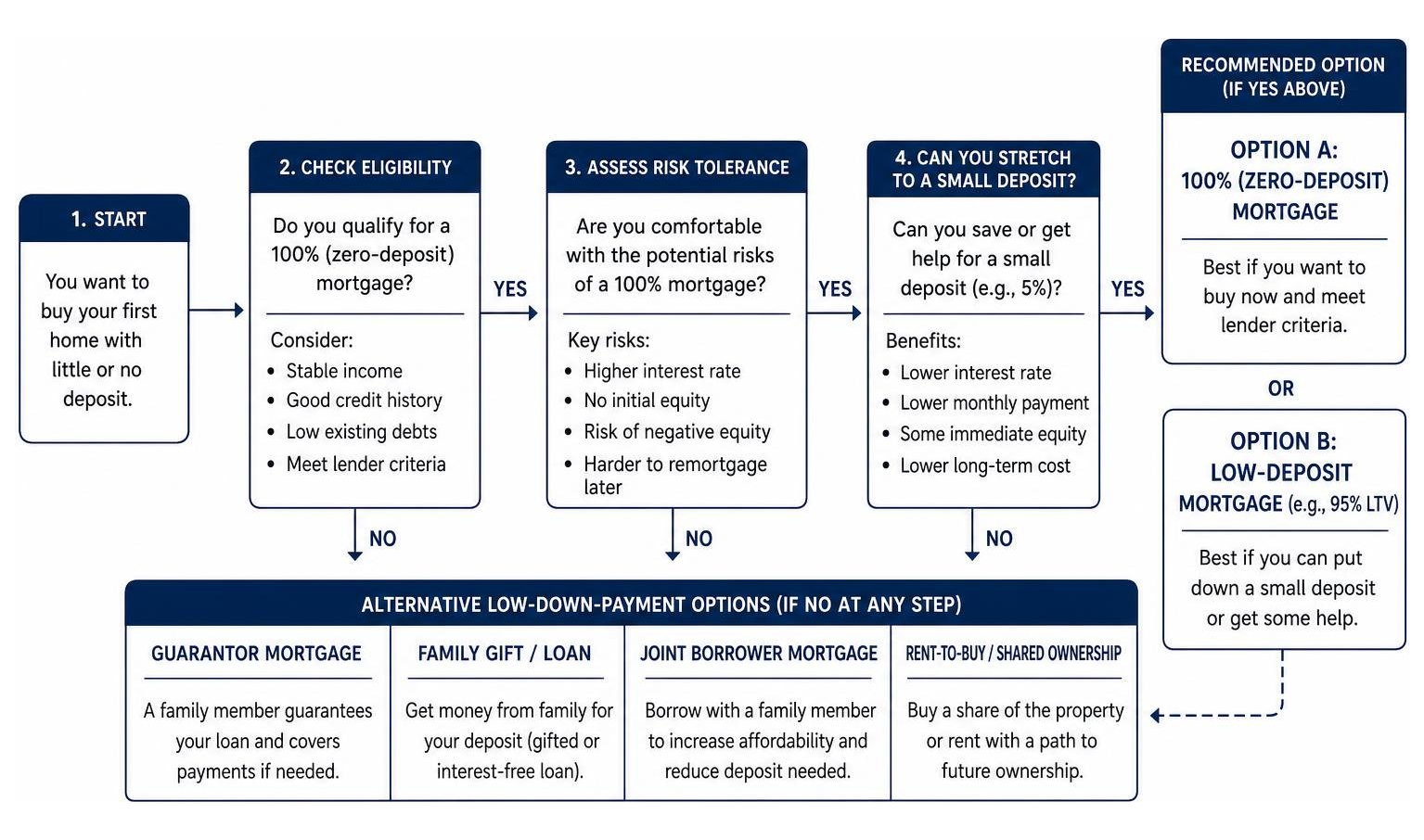
If an unassisted zero-deposit loan is not the best fit for your situation, several flexible alternative financing options exist.
Guarantor and Family Assistance Mortgages
Many low- or no-deposit loans leverage support from family members:
- Guarantor Mortgages: A family member (typically a parent) agrees to back your loan, committing to step in and make payments if you default.
- Family Savings Collateral: A relative deposits cash into a savings account held by the lender. The account earns interest but is locked for a specific period (e.g., 3 to 5 years) as security against default.
- Equity Pledges: Rather than providing cash, a family member registers a legal charge against their own primary residence to provide the extra equity security required by the lender.
Government Schemes and Low-Down Payment Options
If family assistance isn't an option, structured low-down-payment programs offer lower barriers to entry:
- Government-Backed & Flexible Mortgages: Depending on your location and background, programs like FHA Home Loans allow entry with as little as 3.5% down. For eligible military members and veterans, VA Home Loans offer 100% financing options with zero down payment required.
- Rural Financing: Homes in designated suburban and rural communities may qualify for 100% financing via USDA Home Loans.
- Down Payment Assistance: Local and state municipal programs provide grants, second loans, or soft second liens to cover required down payments and closing fees. Learn more about state-level resources through our guide to Down Payment Assistance Programs.
- Shared Ownership: In select housing markets, buyers can purchase a share of a property (between 10% and 75%) and pay subsidized rent on the remainder, drastically lowering the initial deposit required.
Frequently Asked Questions About Zero-Deposit Mortgages
Can I get a 100% mortgage with bad credit?
Securing 100 mortgages for first time buyers with adverse credit (such as recent late payments, collections, or bankruptcy) is difficult. Because zero-deposit loans carry high risk for the lender, standard underwriting guidelines require strong credit profiles.
Specialist lenders or bad-credit brokers may offer high-LTV options, but these products carry higher interest rates, lower borrowing limits, and require proof of strong current income. Improving your credit score prior to applying remains the best path forward.
Do I need a guarantor for a zero-deposit mortgage?
Not always. While many classic zero-deposit structures rely on family guarantors or pledged equity savings, standalone products exist. "Track record" mortgages evaluate your rent payment history as proof of affordability, eliminating the need for a family guarantor or cash deposit.
What happens when it is time to remortgage a 100% loan?
When your initial fixed-rate term ends (typically after 2 to 5 years), your loan automatically transitions to the lender's Standard Variable Rate (SVR), which is often much higher. To avoid higher payments, you will want to refinance.
If your property has grown in value or you have paid down loan principal, your LTV ratio will have dropped, unlocking better refinancing deals. If property values have stagnated or fallen, your remortgaging choices may be limited until you build additional principal equity.
Conclusion
100 mortgages for first time buyers offer a practical pathway onto the property ladder without waiting years to accumulate a traditional cash deposit. However, zero-down home financing carries clear financial tradeoffs, including higher monthly payments, increased interest costs over time, and a greater risk of negative equity if real estate markets shift.
Evaluating whether a zero-deposit loan, a 95% LTV mortgage, or a low-down-payment assistance program aligns with your goals requires a clear look at your overall budget. Taking time to run figures and prepare your finances ensures you enter homeownership with confidence.
Ready to explore your options and find the right loan structure for your budget? Visit Home Loan Advisors to learn how to Buy a Home with expert support at every step.