
The Ultimate Guide to 15-Year Fixed Investment Property Options
Is a 15-Year Fixed Investment Property Loan the Right Fit?
A 15 year fixed investment property loan can build equity much faster than a longer-term mortgage, but the higher monthly principal-and-interest payment may reduce rental cash flow. Before choosing one, compare the full payment - principal, interest, taxes, insurance, and any HOA dues - against realistic rent, vacancy, repairs, and management costs.
For a Tampa, St. Petersburg, or Clearwater rental, a 15-year term may be worth exploring when:
- The property has strong rent relative to its price and operating costs.
- You have reserves for repairs, vacancies, insurance changes, and tax reassessments.
- Building equity and reducing long-term interest matter more than maximizing monthly cash flow.
- The deal still works when you use conservative rent and expense assumptions.
Florida carry costs can change the picture quickly. Property taxes, wind coverage, flood insurance where applicable, and HOA fees may make a short loan term harder to support than the advertised rate suggests. A longer term may provide more payment flexibility; a 15-year term may accelerate principal reduction. The right choice depends on the property, your reserves, and your investment plan.
I’m Josh Jampedro, a Tampa mortgage broker and vice president, and I’ll walk through how to compare these options clearly before you commit to a financing structure.
Understanding 15-Year Fixed Mortgages for Real Estate Investors
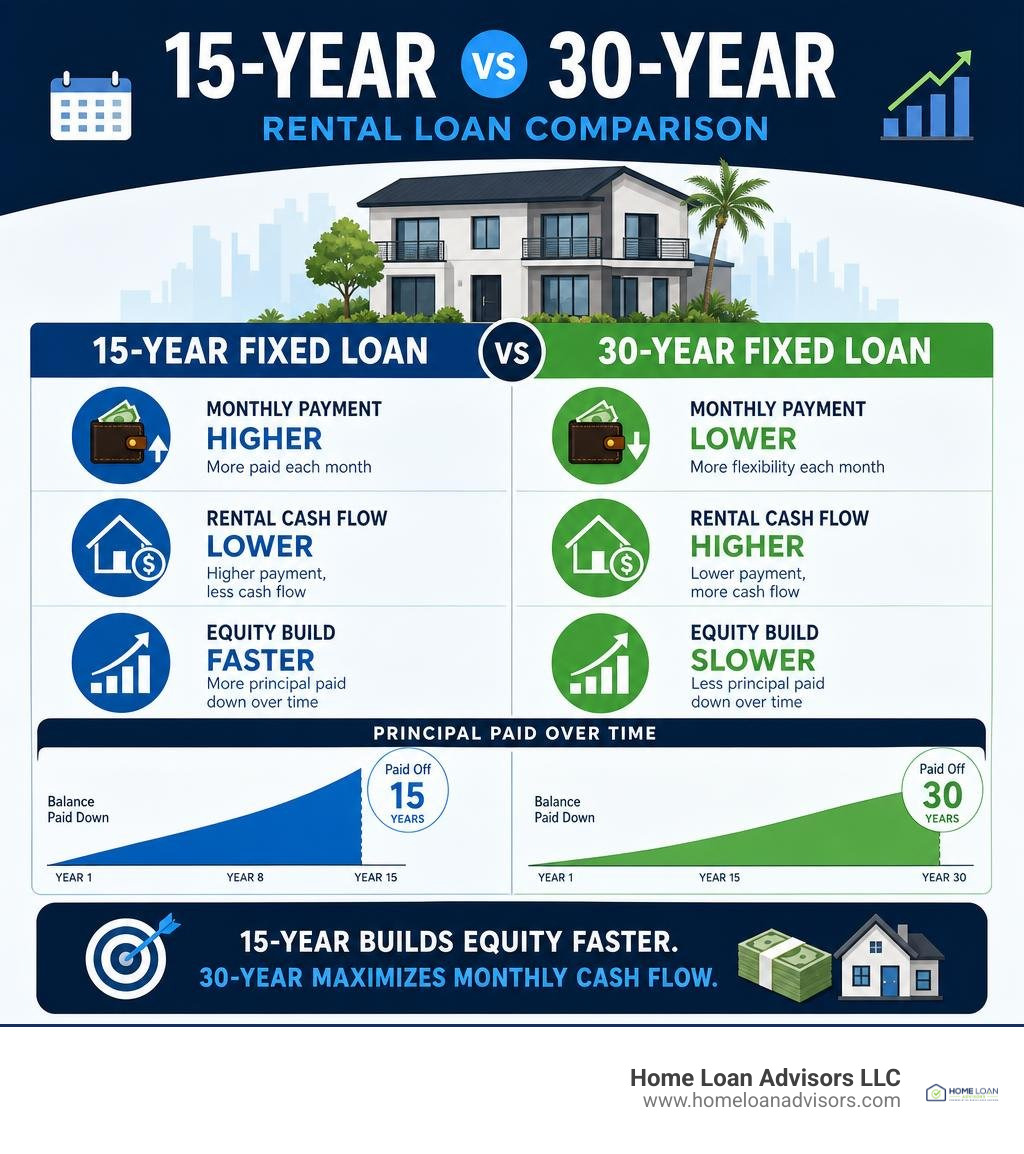
When structuring financing for non-owner-occupied real estate, the amortization schedule dictates your balance sheet trajectory. A 15 Year Fixed Mortgage requires you to pay down the entire loan balance over 180 monthly payments instead of 360.
Because the repayment timeline is compressed, each monthly payment applies a substantially larger share toward principal reduction from day one. Over the life of the loan, this structure slashes overall interest expense in half compared to a standard 30-year loan.
In Florida markets across Hillsborough and Pinellas counties, investors often weigh whether to prioritize immediate passive income or rapid debt elimination. The contrast between these two approaches comes down to how capital is allocated each month.
| Loan Feature | 15-Year Fixed Investment Term | 30-Year Fixed Investment Term |
|---|---|---|
| Amortization Period | 180 months | 360 months |
| Principal Paydown Speed | Accelerated from month one | Back-loaded into later years |
| Total Lifetime Interest | Substantially lower overall cost | Higher cumulative interest carry |
| Monthly Debt Service | Higher required monthly payment | Lower baseline monthly obligation |
| Monthly Net Cash Flow | Compressed distributions | Maximized monthly liquid margin |
| Equity Accumulation | Rapid balance sheet growth | Gradual baseline buildup |
Investor Loan Pricing and Term Comparisons
Mortgage lenders price investment property debt differently than primary residential financing. Non-owner-occupied loans represent a different risk profile for capital markets, which results in standard pricing adjustments.
Generally, shorter-term fixed mortgages carry lower baseline interest rates than longer-term options due to reduced duration risk for lenders. However, investor loans carry loan-level price adjustments regardless of the term. Keeping track of changing 15 Year Home Interest Rates allows you to gauge how the pricing gap between 15-year and 30-year options shifts alongside broader capital market movements. Analyzing local market fundamentals can also help you pinpoint neighborhoods where strong rents support shorter amortization periods.
Second Home Rules vs Pure Rental Properties
A common point of confusion among buyers purchasing property in coastal Florida involves the regulatory line between a second home and an investment property.
Under conventional guidelines, a second home must be occupied by the borrower for a meaningful portion of the year (often aligned with IRS standards of at least 14 days or 10% of total rental days) and remain under the owner's exclusive control. Rental income cannot be used to qualify for a second home loan.
If you plan to rent out the property year-round, or if you need prospective rental income to meet qualification standards, the transaction must be classified as an investment property. This distinction impacts your minimum down payment, reserve assets, and qualifying guidelines.
Evaluating Cash Flow and ROI on a 15 Year Fixed Investment Property
A 15-year loan changes the monthly math on a rental property. Because the monthly debt service is higher, your cash flow cushion is tighter.
To evaluate whether a deal functions safely, you must account for all components of the monthly obligation: principal, interest, property taxes, hazard insurance, flood insurance (when in designated flood zones), and any applicable association dues. You can model these scenarios using an Investment Property Mortgage Calculator — PITI + Cash Flow to verify that your gross rent covers both operating expenses and accelerated debt service.
DSCR Underwriting for a 15 Year Fixed Investment Property
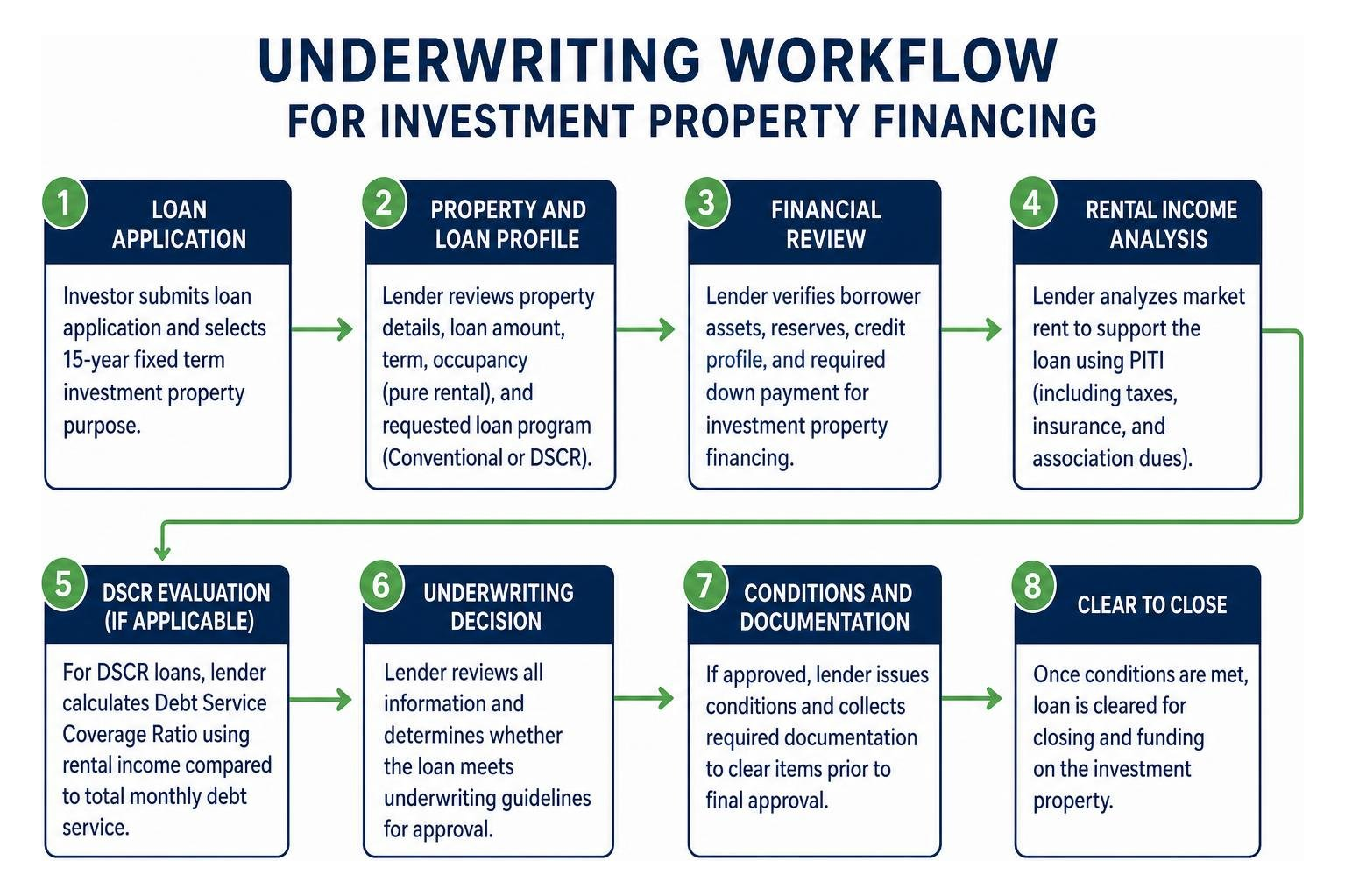
For investors using Debt Service Coverage Ratio (DSCR) loans, qualification is based on the property’s cash flow rather than personal tax returns or pay stubs.
In residential DSCR underwriting, lenders calculate the coverage ratio using this formula:
$$\text{DSCR} = \frac{\text{Gross Monthly Rent}}{\text{Monthly PITIA}}$$
Lenders evaluate market rent using Fannie Mae Form 1007 or signed lease agreements. Because a 15-year amortization raises the monthly principal-and-interest component, the total PITIA denominator increases. This means a property that achieves a strong DSCR on a 30-year term might produce a tighter ratio on a 15-year term.
You can run your property metrics through a specialized DSCR Loan Calculator to see how debt service structures impact qualification tiers across different portfolio programs.
Break-Even Rent Factors for a 15 Year Fixed Investment Property
Break-even rent is the minimum gross rental revenue required to pay all property expenses and debt service without operating at a monthly deficit.
Many new investors make the mistake of assuming break-even equals monthly PITIA. In practice, true operational break-even must include:
- Vacancy buffers (typically 5% to 8%)
- Maintenance and structural capital expenditure reserves
- Routine property management fees
- Ongoing municipal utilities or licensing fees
When using an interactive Mortgage Calculator to test scenarios, ensure you layer these operating allowances on top of your baseline mortgage payment to verify that local market rents support the higher debt payment.
Loan Types and Qualification Criteria for 15-Year Terms

Financing an investment asset on a 15-year term can be accomplished through several distinct lending channels. Each has specific requirements:
- Conventional Conforming Financing: Requires full income documentation (W-2s or tax returns), liquid post-closing reserves, and credit profile validation according to Fannie Mae and Freddie Mac standards.
- DSCR / Non-QM Financing: Focuses primarily on asset-level cash flow and credit history, offering flexibility for self-employed investors or entities like LLCs.
- Portfolio and Commercial Financing: Carried on bank balance sheets with tailored guidelines for multi-unit properties or unique collateral.
Before making offers on properties in Tampa, St. Petersburg, or Clearwater, getting a formal Pre Approval establishes your borrowing parameters and ensures your documentation meets lender guidelines.
A standard investment loan package typically requires:
- Verification of down payment funds and source documentation
- Asset statements demonstrating required post-closing liquidity reserves
- Credit history documentation
- Subject property lease agreements or appraisal rent schedules
- Entity documentation if vesting under an LLC or corporate structure
(Note: Human compliance review required for conventional, FHA, VA, and USDA eligibility language.)
Florida Property Tax and Insurance Considerations
In Florida, carrying costs are a major factor in overall loan performance. When analyzing rental properties in Hillsborough County, Pinellas County, and coastal zones, these line items require careful planning:
- Property Tax Reassessments: A purchase triggers a reassessment based on the new acquisition value, which removes previous homestead caps and can increase future annual tax bills.
- Hazard and Windstorm Coverage: Premiums reflect wind mitigation features, roof age, and construction materials.
- Flood Insurance: Properties located in special flood hazard areas require separate flood policies that must be factored directly into your escrow payment.
Failing to budget for localized insurance and tax realities can turn a modestly cash-flowing 15-year loan into a monthly cash drain.
Portfolio Scaling and Refinancing Strategies
A 15-year fixed loan is an effective tool for building equity quickly. As your tenant pays down the loan balance, your net worth in the property grows at an accelerated rate.
Some investors use a 15-year term to achieve a free-and-clear asset quickly, creating stable income streams for retirement. Others use the accumulated equity to Refinance later, restructuring the debt into a longer amortization to boost monthly cash distributions when their investment priorities shift.
Frequently Asked Questions About 15-Year Investment Mortgages
How does a 15-year loan affect monthly rental cash flow?
A 15-year loan requires higher monthly principal payments than a 30-year loan, which reduces your net monthly cash distributions. However, a much larger portion of every payment goes directly toward paying down your loan balance rather than interest, allowing you to build equity much faster.
What debt service coverage ratio is typically needed for approval?
Most DSCR programs look for a coverage ratio between 1.15 and 1.25 on the total PITIA payment to qualify for standard terms, though some programs offer options for lower ratios depending on credit history and down payment assets.
Can I refinance a 30-year rental loan into a 15-year fixed loan?
Yes. If market conditions, property appreciation, or rising rental rates have improved your equity position, refinancing into a 15-year fixed loan allows you to shorten your payoff timeline and reduce total remaining interest costs.
Conclusion

Choosing the right financing structure for your rental property depends on your financial goals, liquidity reserves, and overall portfolio strategy. While a 15-year fixed investment property loan requires higher monthly debt service, it provides a clear path to debt-free ownership and substantial long-term interest savings.
Whether you are acquiring a duplex in St. Petersburg, a single-family rental in Tampa, or expanding your portfolio across Florida, Home Loan Advisors LLC provides tailored mortgage strategies built around transparent guidance.
If you are exploring financing options for your next property, reach out to Josh Jampedro (NMLS #1082889) to discuss what loan structure makes the most sense for your situation. Learn more about our approach to a 15 Year Fixed Mortgage and how we can support your long-term investment plans.
Equal Housing Lender. Equal Housing Opportunity. Home Loan Advisors LLC. Josh Jampedro NMLS #1082889.
Mortgages are complex so let me give you the tools you need to make the right decisions.