PMI Mortgage Insurance Terms Demystified
Understanding PMI Mortgage Insurance: What It Is and How It Works
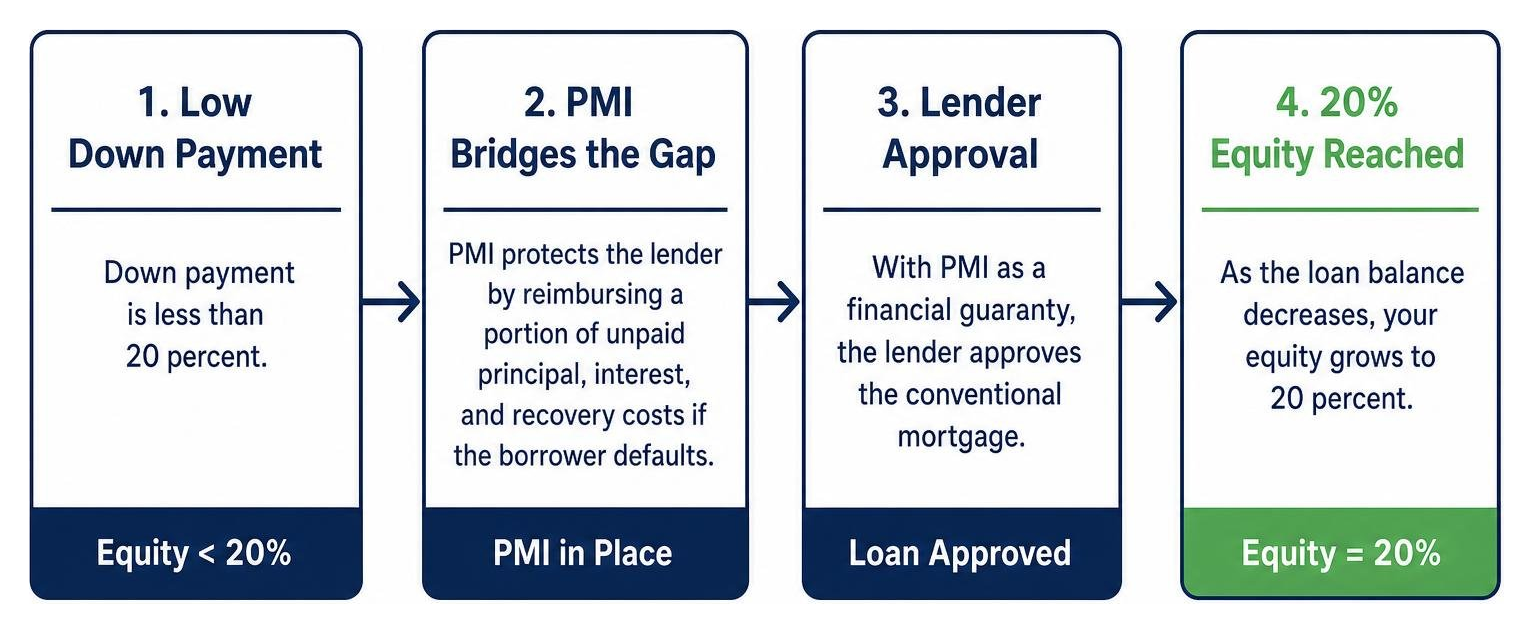
Private mortgage insurance exists to bridge the gap between your available down payment and the traditional 20 percent equity threshold. When evaluating conventional home loans, lenders look at risk exposure. If a borrower defaults on a mortgage with a small down payment, the lender faces potential losses during foreclosure. PMI acts as a financial guaranty that reimburses the lender for a portion of that unpaid principal balance, delinquent interest, and related recovery costs. For prospective homebuyers across Tampa, St. Petersburg, and Clearwater, this coverage serves as a practical mechanism to purchase a home sooner rather than spending extra years attempting to save a full twenty percent cash reserve.
As explained in regulatory guidance on What is private mortgage insurance?, this policy is provided by private companies rather than government entities. It does not protect your personal property, cover your payments if you lose a job, or replace standard homeowners insurance. It solely safeguards the mortgage holder.
Across the United States, private MI has helped nearly 40 million borrowers buy homes since 1957. In 2024 alone, private MI supported nearly $300 billion in purchase and refinance originations, accounting for roughly 42% of the insured market. Government-sponsored enterprises (GSEs) like Fannie Mae and Freddie Mac generally require credit enhancement on conventional loans when the loan-to-value (LTV) ratio exceeds 80%. In 2024, 36.1% of GSE loans carried PMI, with an average loan size of $364,509 and an average LTV of 92.8%.
How Credit Scores Impact PMI Mortgage Insurance Rates
Unlike flat-rate government programs, private mortgage insurance pricing is risk-based. Private insurers use tiered rate cards that evaluate your credit profile, debt-to-income ratio, property type, and LTV.
When considering what credit score do you need for a mortgage, your score directly influences your ongoing monthly premium. For instance, data indicates that GSE PMI borrowers in 2024 carried an average FICO score of 750. Higher credit scores place you in lower risk brackets, reducing the annual premium percentage. A buyer putting 5% down with strong credit might see an annual premium near 0.3% to 0.5% of the loan balance, while a borrower with lower credit scores might face premiums ranging up to 1.5% or 1.86%.
Payment Structures: Monthly, Upfront, and Split Premiums
Homebuyers have several distinct ways to structure private mortgage insurance premiums based on their cash flow and long-term plans:
- Borrower-Paid Monthly PMI (BPMI): The standard structure. The premium is split into 12 installments and added directly to your monthly mortgage escrow payment alongside property taxes, hazard insurance, and any relevant flood policies common across coastal Florida.
- Single-Premium Upfront PMI (SPMI): You pay the entire premium in a lump sum at closing, or finance it into the total loan balance if guidelines permit. This keeps your monthly payment lower, but the upfront fee is generally non-refundable if you sell or refinance shortly afterward.
- Split-Premium PMI: A hybrid approach where you pay a portion upfront at closing and a smaller recurring monthly fee. This can help balance closing cash reserves with monthly cash flow constraints.
- Lender-Paid Mortgage Insurance (LPMI): The lender pays the mortgage insurance premium on your behalf, but incorporates that cost into a slightly higher interest rate for the life of the loan. Unlike BPMI, LPMI cannot be cancelled once you reach 20% equity; eliminating it requires a full refinance.
Comparing Conventional PMI and Government Mortgage Insurance
When selecting financing for properties across Tampa, St. Petersburg, and Clearwater, borrowers often weigh conventional financing against government-backed alternatives. Understanding What Is Private Mortgage Insurance? helps clarify how conventional protection contrasts with government agency guarantees.
Conventional PMI vs FHA Mortgage Insurance Premiums
Federal Housing Administration loans use Mortgage Insurance Premiums (MIP) rather than private insurance. While FHA home loans provide accessible underwriting guidelines for diverse credit profiles, their insurance structure operates differently:
| Feature | Conventional Loan (PMI) | FHA Loan (MIP) |
|---|---|---|
| Upfront Fee | Optional (Single-Premium) | Required (Upfront MIP added to loan) |
| Monthly Premium | Based on credit score and LTV | Mostly flat across credit tiers |
| Cancellation at 80% LTV | Yes, by borrower request | Rarely (often lasts the life of loan) |
| Automatic Termination | Yes, at 78% original LTV | No (if down payment was under 10%) |
| Provider | Private MI Companies | Federal Housing Administration |
For a homebuyer in the Clearwater market with strong credit, conventional PMI is often more cost-effective over time because the monthly fee can be removed once sufficient equity is achieved, avoiding the need to refinance down the road. In contrast, FHA financing may carry annual MIP for the entirety of the mortgage term when putting down less than ten percent at purchase.
Down Payment Options and Piggyback Loan Alternatives
If you want to manage monthly mortgage insurance costs, you can explore second mortgages or piggyback financing structures, such as an 80-10-10 loan. In this arrangement, you take an 80% first mortgage, a 10% second mortgage (or home equity line of credit), and put 10% cash down. Because the primary lien stays at 80% LTV, private mortgage insurance is not required on the first loan.
Additionally, buyers can review state and local down payment assistance programs across the Tampa area to evaluate whether supplemental grant or subordinate financing helps reduce initial LTV ratios while preserving personal savings for moving expenses and reserves.
Strategic Ways to Manage and Cancel Coverage

Because private mortgage insurance is tied to loan balance and equity, tracking your home's amortization schedule with a reliable mortgage calculator gives you clear visibility into your cancellation timeline.
Removing PMI Mortgage Insurance from Your Loan
Under the federal Homeowners Protection Act (HPA), borrowers holding conventional residential mortgages have rights regarding cancellation:
- Borrower-Requested Cancellation (80% LTV): You have the right to request PMI removal in writing once your principal balance reaches 80% of the original purchase value. You must maintain an on-time payment history without recent 30-day or 60-day delinquencies, and the lender may require a professional appraisal to verify property value has not declined.
- Automatic Termination (78% LTV): Servicers are required by law to cancel borrower-paid PMI automatically when your mortgage balance reaches 78% of the original value based on the initial amortization schedule, provided your payments are current.
- Appreciation-Based Removal: If substantial property appreciation or home renovations in neighborhoods across Tampa or St. Petersburg increase your equity, you can ask your servicer for cancellation based on current market value. Lenders typically require a minimum seasoning period (often 2 to 5 years) and a verified appraisal confirming an LTV of 75% to 80% or lower. This makes monitoring Pinellas and Hillsborough county property values a sensible habit for local homeowners.
Tax Considerations and Long-Term Cost Impacts
Historically, mortgage insurance premium deductibility has shifted across tax legislation cycles. From 2007 through 2021, an average of 3.4 million homeowners annually claimed tax deductions for MI premiums, totaling $64.7 billion. Following legislative updates, including provisions under the One Big Beautiful Bill Act, MI deductibility rules can vary based on adjusted gross income and itemization status. Consult a qualified tax advisor to understand how MI payments affect your specific tax position.
Frequently Asked Questions About Mortgage Insurance
How much does private mortgage insurance typically cost?
Annual PMI premiums generally range from 0.3% to 1.5% (and occasionally up to 1.86%) of the initial loan amount each year. On a $300,000 loan balance, that equates to roughly $75 to $375 per month, depending heavily on your credit score, down payment size, and property occupancy.
Does PMI protect the homebuyer if they face financial hardship?
No. Private mortgage insurance protects the mortgage lender against default losses. It does not provide disability payments, unemployment relief, or hazard repair coverage. Separate products like mortgage protection insurance (MPI) or private disability policies address personal hardship.
Can making extra principal payments cancel PMI early?
Yes. Making extra principal payments accelerates your amortization, lowering your unpaid balance toward the 80% original value threshold faster than the standard schedule. Once reached, you can contact your servicer to initiate cancellation.
Conclusion
Understanding what is PMI mortgage insurance gives you a strategic advantage when planning your home purchase in Tampa, St. Petersburg, Clearwater, or across Florida. Rather than seeing PMI as an obstacle, many buyers view it as a practical tool that allows them to purchase real estate sooner without depleting all their cash reserves.
If you are ready to explore conventional, FHA, or alternative loan structures, getting a comprehensive pre-approval is a helpful first step to assess your purchasing power and total monthly costs.
Contact Home Loan Advisors to discuss your specific goals and compare financing options tailored to your needs.
Josh Jampedro | Vice President, Home Loan Advisors LLC
NMLS #1082889 | Equal Housing Lender
Compliance Flag: Conventional, FHA, VA, and USDA loan eligibility subject to standard underwriting, credit verification, and agency guidelines.
Mortgages are complex so let me give you the tools you need to make the right decisions.