Navigating the FHA 203k Renovation Loan: Steps, Rules, and Project Types
Understanding How the Renovation Loan FHA 203k Program Works
When buying an older property in neighborhoods across Tampa, St. Petersburg, or Clearwater, finding a home that matches your exact taste and passes a standard appraisal can prove challenging. Many traditional mortgages require a house to meet strict habitability standards before closing. If a property has a failing roof, an outdated electrical panel, or termite damage, a seller might have to fix it before you can buy—or you might walk away.
That is where a renovation loan fha 203k changes the conversation. Administered through approved lenders and insured by the federal government under the 203(k) Rehabilitation Mortgage Insurance Program, this mortgage lets you bundle the purchase price (or existing mortgage balance if refinancing) and the estimated cost of repairs into a single long-term loan.
Unlike standard FHA home loans that assess the property strictly in its "as-is" condition, a 203(k) loan is underwritten based on the projected "after-improved" market value. An FHA appraiser reviews your architectural exhibits, contractor estimates, and proposed work write-ups to determine what the home will be worth once all renovations are completed.
To participate in the program, the property must be at least one year old and serve as your primary residence. While investors cannot use the 203(k) program to flip unoccupied houses, owner-occupants can use it on 1- to 4-unit properties, enabling you to live in one unit while renovating the entire building.
Limited vs. Standard: Choosing Your Renovation Loan FHA 203k Option
The FHA 203(k) program is divided into two distinct tracks: the Limited 203(k) and the Standard 203(k). Deciding which option fits your situation depends entirely on the scope and structural nature of your planned improvements.
| Program Feature | Limited 203(k) | Standard 203(k) |
|---|---|---|
| Minimum Repair Budget | No official minimum | $5,000 |
| Maximum Repair Budget | Up to $75,000 (Case numbers on/after 11/4/2024) | Up to statutory FHA county loan limit |
| Structural Alterations | Not permitted (non-structural only) | Permitted (additions, moving load-bearing walls) |
| HUD-Approved Consultant | Optional (rarely required) | Mandatory |
| Escrow Draw Payments | Streamlined (often up front + final) | Multi-stage draws aligned with project milestones |
| Displacement Allowance | Home must remain habitable during repairs | Up to 6 months of mortgage payments may be financed |
The Limited 203(k) is designed for minor remodeling and non-structural upgrades. For FHA case numbers assigned on or after November 4, 2024, the financing cap for repairs under the Limited program was increased to $75,000. It works well for updates like remodeling a kitchen, modernizing bathrooms, replacing an aging HVAC unit, or installing new flooring.
The Standard 203(k) requires a minimum of $5,000 in repairs and has no maximum repair cap, provided the total mortgage remains within local FHA loan limits. If your project involves moving load-bearing walls, adding square footage, fixing a compromised foundation, or completely reconfiguring a floor plan, the Standard program is the correct path.
Under the Standard track, you are required to work with an independent, HUD-approved 203(k) consultant. This professional inspects the property, prepares the formal architectural exhibits and cost write-up, conducts site inspections, and signs off on contractor draw requests before funds leave the escrow account.
Eligibility Rules, Property Standards, and Borrower Requirements
Qualifying for a 203(k) renovation mortgage involves evaluating both your personal financial profile and the specific property you want to improve.
From a borrower perspective, FHA guidelines generally offer flexibility, but individual mortgage lenders often set their own underwriting overlays. When evaluating what credit score you need for a mortgage, standard baseline FHA guidelines may permit scores starting at 580 for maximum financing, but many lenders and secondary market investors establish higher minimums. For example, some institutions require a minimum FICO score of 660 for renovation products.
Your debt-to-income (DTI) ratio, steady employment history, and proof of funds for your down payment and closing costs are verified during underwriting. If you have run into hurdles previously or experienced trouble getting pre-approved, addressing credit report errors and reducing revolving debt balances can help strengthen your profile.
From a property perspective, the home must meet the valuation and eligibility criteria outlined in HUD Handbook 4240.4. Eligible property types include:
- Single-family detached homes
- 2- to 4-unit residential properties (where you occupy one unit)
- Townhomes and certain FHA-approved condominiums (interior non-structural work only)
- Mixed-use properties, provided the building is at least 51% residential and the rehabilitation applies strictly to the residential portion
Certain properties, such as cooperative units or manufactured homes that are not permanently affixed to real estate, do not qualify for the 203(k) program.
Eligible Upgrades and Project Types Under a Renovation Loan FHA 203k
The 203(k) program is intentionally flexible, allowing homeowners to tackle safety issues, functional obsolescence, and modern design preferences in one project.
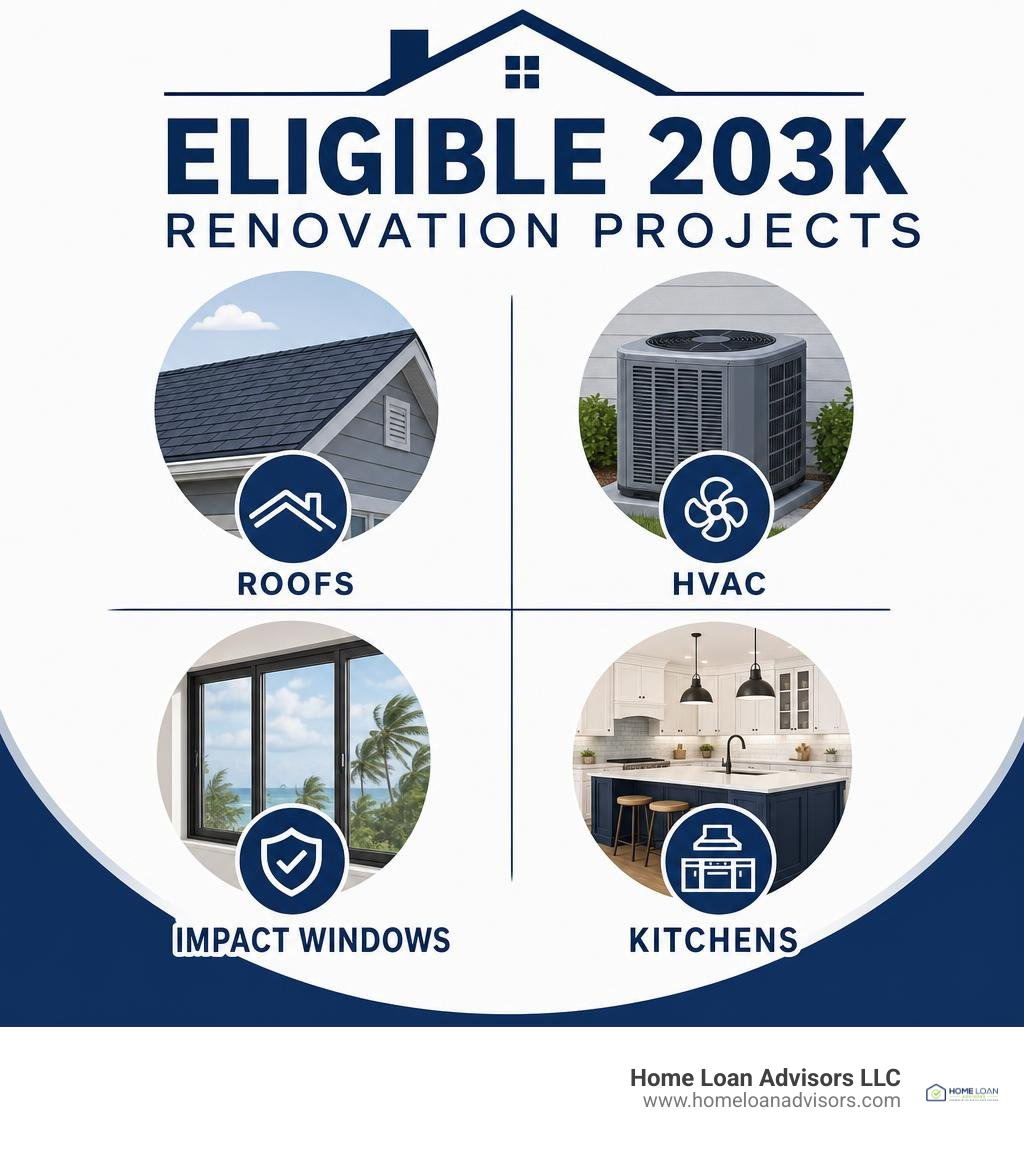
Common eligible improvements include:
- Structural Alterations & Additions: Modifying load-bearing walls, adding a second story, expanding a bedroom, or repairing broken foundation slabs (Standard 203(k) only).
- Roofing, Siding, & Gutters: Replacing older shingles with architectural shingles, repairing sub-roof decking, and upgrading exterior fascia.
- Weatherization & Coastal Protection: Installing hurricane-rated impact windows and exterior doors, upgrading insulation, and replacing weather-stripping.
- HVAC & Systems Modernization: Installing energy-efficient heat pumps, replacing outdated ductwork, updating electrical panels, and re-plumbing broken piping.
- Kitchen & Bathroom Remodeling: Installing new cabinetry, stone countertops, sinks, tile backsplashes, bathtubs, and modern plumbing fixtures.
- Health, Safety, & Hazard Remediation: Eliminating lead-based paint hazards, mitigating mold issues, repairing damaged steps, or installing safety handrails.
- Accessibility Improvements: Adding wheelchair ramps, widening doorways, lowering countertop heights, and converting bathtubs into roll-in showers.
- Energy Efficiency & Green Upgrades: Integrating qualified solar or wind energy components, high-efficiency water heaters, and modern appliance suites.
Note on Luxury Items: The FHA 203(k) program is intended for rehabilitation, health, safety, and modern comfort. It does not finance luxury additions such as installing a brand-new swimming pool, building an outdoor barbecue kitchen, or adding a tennis court. However, existing swimming pools that have fallen into disrepair can often have their mechanical systems and surfaces repaired using loan funds.
The Step-by-Step 203(k) Origination and Escrow Draw Process
Because an FHA 203(k) loan involves active construction, its process has a few more steps than a conventional purchase mortgage. Understanding the workflow helps keep your closing and renovation timeline on track.
1. Pre-Approval and Budget Planning
Your first step is obtaining a detailed mortgage pre-approval. This establishes your maximum total loan amount based on your income, assets, and credit profile. Knowing your total capacity allows you to calculate how much you can allocate toward the property purchase price versus the planned renovation budget.
2. Property Selection and Feasibility Analysis
Once under contract on an eligible home, you determine whether the project requires a Limited or Standard 203(k). If you are using the Standard track, you will select an independent HUD-approved 203(k) consultant to perform a preliminary feasibility inspection and prepare a detailed work write-up.
3. Sourcing Licensed Contractor Bids
You will select one or more licensed and insured general contractors. Your contractor must provide a detailed, itemized bid that breaks down labor and material expenses for every planned item in the scope of work. Lenders do not allow unvetted or unlicensed handymen to execute 203(k) projects.
4. Appraisal and Underwriting
The appraiser receives your purchase contract and the contractor's proposed scope of work. They inspect the property and establish the projected "after-improved value." The underwriter reviews your financial documentation, contractor credentials, and property valuation to issue the final loan approval.
5. Closing and Escrow Account Setup
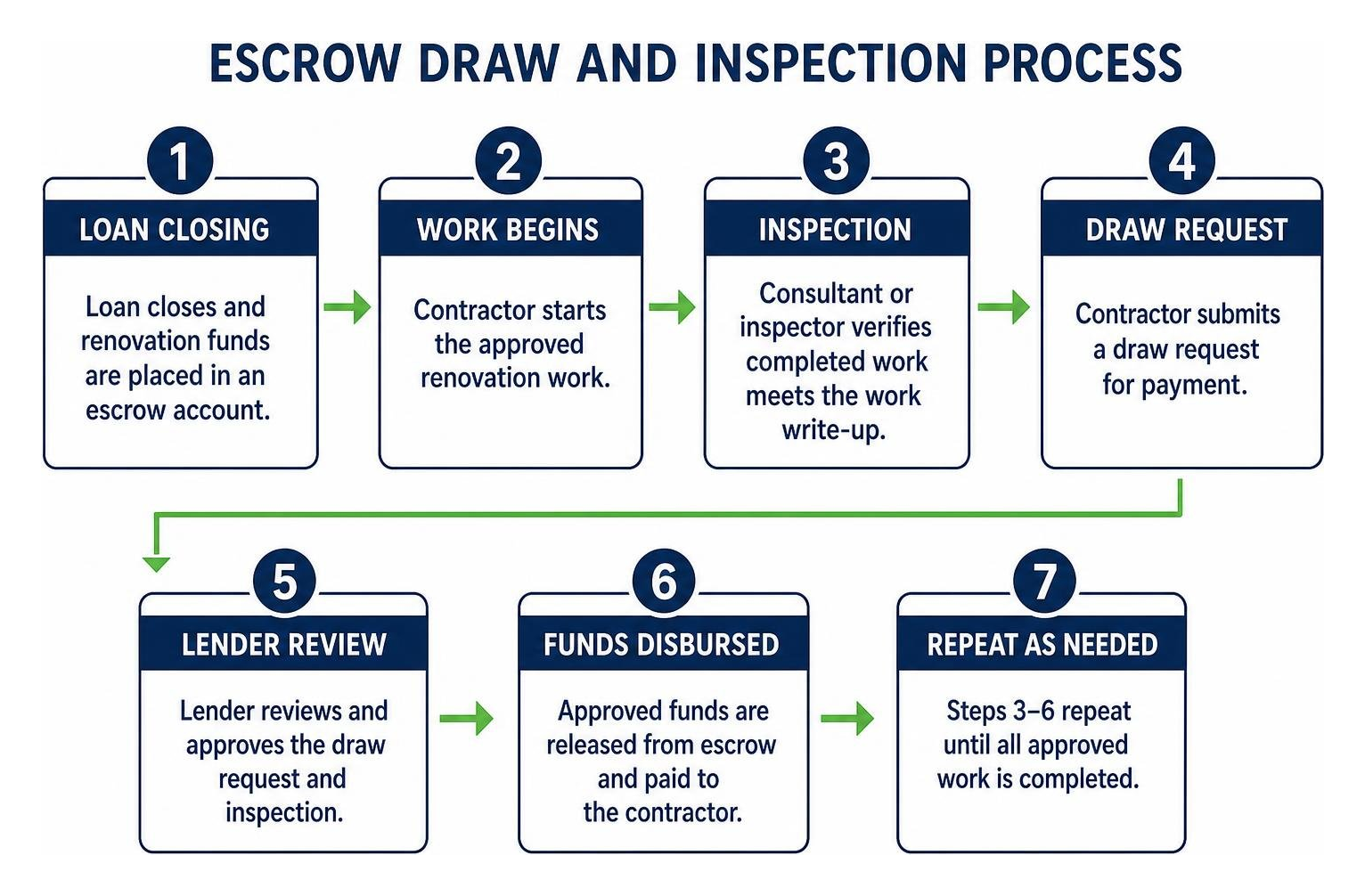
At closing, the seller receives their proceeds for the purchase price, and the repair funds are placed into an interest-bearing rehabilitation escrow account. You do not receive the construction money directly in cash.
6. Construction and Draw Disbursements
Work must begin within 30 days of closing and must be completed within the timeline established in your rehabilitation agreement (typically within 6 months).
As work finishes across different phases:
- The contractor requests a draw payment.
- An inspector (or your HUD consultant) visits the site to verify the work was completed according to code and the approved scope.
- The inspector signs a draw release form.
- The lender issues payment jointly to you and the contractor from the escrow account.
7. Final Inspection and Escrow Closure
Once all repairs are completed, a final inspection is performed, lien waivers are collected from all contractors and material suppliers, and any leftover contingency reserve funds are applied directly toward reducing your principal loan balance.
Frequently Asked Questions About FHA 203(k) Financing
How much money can you borrow for repairs on a Limited 203(k)?
Under the Limited 203(k) program, you can finance up to $75,000 in eligible repairs for loans with FHA case numbers assigned on or after November 4, 2024. The total mortgage amount—which includes the purchase price plus the renovation budget—must still fall within the statutory FHA county loan limits established for your specific area.
Can you do the renovation work yourself with an FHA 203(k) loan?
In most cases, no. FHA guidelines strongly emphasize using licensed, insured, and experienced general contractors to ensure all repairs are completed in a workmanlike manner and meet local building codes. While HUD guidelines have historic provisions for "self-help" arrangements, mortgage lenders rarely permit borrowers to do their own labor unless the borrower can document by trade that they are a licensed contractor. If you are exploring alternative ways to finance home repairs, comparing this structure against another specialized rehab loan can help you decide which setup matches your timeline.
What happens if the repair costs exceed the initial estimate?
To protect against unexpected issues—such as discovering hidden water damage or outdated wiring behind drywall—every 203(k) loan includes a contingency reserve. This reserve typically ranges from 10% to 20% of the total repair estimate and is financed into the escrow account. If an unforeseen repair arises, your contractor submits a formal change order to the lender and consultant. If approved, funds from the contingency reserve cover the extra cost. If no extra expenses occur during the project, the unused contingency money is applied to reduce your loan principal.
Conclusion
Turning a fixer-upper into a comfortable home does not have to mean draining your personal savings or taking on high-interest credit card debt. Whether you are looking at a historic 1920s bungalow in Seminole Heights, a mid-century home in St. Petersburg, or a coastal property near Clearwater that needs modernization, an FHA 203(k) loan provides a structured way to buy and renovate under a single mortgage.
At Home Loan Advisors, we believe in an education-first approach to mortgage lending. Navigating contractor bids, structural consultants, escrow accounts, and property appraisals requires clear planning, and having experienced guidance makes all the difference.
If you are exploring whether an FHA 203(k) loan aligns with your renovation goals and budget, let's connect to discuss your plans.
Mortgages are complex so let me give you the tools you need to make the right decisions.
Josh Jampedro | Vice President | NMLS #1082889 | Home Loan Advisors LLC | Equal Housing Lender
FHA program eligibility language should receive human compliance review. Contact your mortgage advisor for specific terms, guidelines, and current lending parameters.