The Complete Guide to Comparing 30-Year Fixed Rates
Understanding the 30 Year Conforming Fixed Mortgage
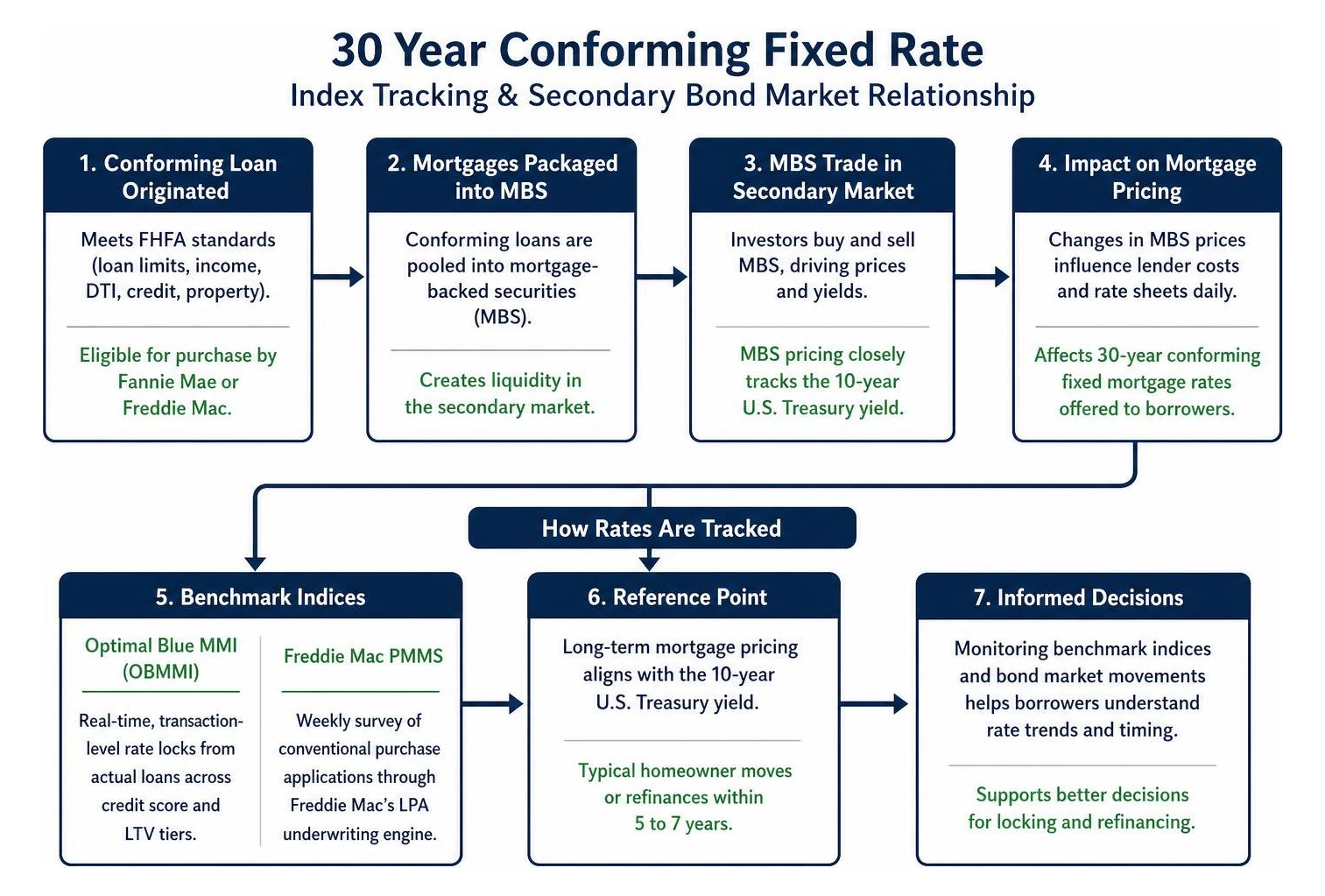
When you explore conventional home loans, understanding what "conforming" means makes a significant difference in how your loan is priced and approved. A conforming loan adheres to specific funding criteria established by the Federal Housing Finance Agency (FHFA) and is eligible for purchase by government-sponsored enterprises (GSEs), primarily Fannie Mae and Freddie Mac.
Because these entities package eligible mortgages into mortgage-backed securities (MBS) on the secondary market, conforming loans benefit from exceptional liquidity. Lenders can offer structured terms and straightforward guidelines because they know these loans meet standardized national requirements.
Key baseline standards include:
- Standardized loan limit caps adjusted annually by the FHFA based on regional home price changes.
- Verification of steady income, assets, and debt-to-income (DTI) ratios through automated underwriting systems.
- Credit score evaluation, where knowing what credit score do you need for a mortgage helps determine your eligible pricing tiers and private mortgage insurance rates.
Conforming Loan Limits and Eligibility Standards
The FHFA sets conforming loan limits every year. Mortgages that fit beneath this baseline threshold are considered conforming, while balances that exceed it fall into non-conforming or "jumbo" territory. Jumbo loans often carry distinct down payment, reserve, and documentation requirements because they cannot be sold directly to Fannie Mae or Freddie Mac.
Qualifying for a conforming mortgage involves several core components:
- Debt-to-Income (DTI) Ratios: Automated underwriting engines generally look for DTI ratios at or below 45% to 50%, depending on compensating factors such as cash reserves, loan-to-value (LTV) ratio, and overall credit history.
- Down Payment Minimums: While many buyers put down 20% to avoid private mortgage insurance (PMI), eligible conventional programs permit down payments as low as 3% to 5% for qualified borrowers.
- Property Requirements: The home must serve as an eligible single-family residence, planned unit development (PUD), townhome, or warrantable condominium, verified through a standard property appraisal.
In markets like Tampa Bay, staying within conforming limits allows buyers in neighborhoods from Seminole Heights to South Tampa or Lakewood Ranch to secure standardized financing terms without entering the specialized underwriting channels required for jumbo debt.
Tracking Benchmark Indices for a 30 Year Conforming Fixed Rate
Mortgage pricing changes daily based on movements in secondary bond markets. If you want to understand how rates are moving, it helps to know which benchmarks lenders and analysts watch.
There are two primary data series commonly referenced in national reporting:
- The Optimal Blue Mortgage Market Indices (OBMMI): Hosted on FRED (Federal Reserve Bank of St. Louis), this index reflects real-time, transaction-level rate locks processed across more than one-third of all residential mortgage volume nationwide. It captures live pricing from actual locked loans across specific credit score bands and LTV tiers.
- Freddie Mac Primary Mortgage Market Survey (PMMS): Published weekly since 1971, PMMS aggregates conventional purchase application data submitted directly through Freddie Mac's Loan Product Advisor (LPA) underwriting engine between Thursday morning and Wednesday night.
Rather than mirroring short-term Federal Reserve rate changes point-for-point, long-term mortgage pricing closely tracks the 10-year U.S. Treasury yield. Because the typical homeowner moves or refinances within 5 to 7 years, the average lifespan of a 30-year mortgage aligns closely with 10-year bond durations. Keeping an eye on benchmark rate comparison resources helps you observe broad pricing patterns across the financial markets.
Comparing Loan Programs and Amortization Structures
Choosing the right mortgage structure comes down to your financial priorities, timeline, and risk tolerance. While a standard 30-year fixed mortgage represents roughly 90% of home purchase financing across the country, comparing it to other loan types ensures you make an informed decision.
| Loan Program | Interest Rate Structure | Monthly Payment Predictability | Equity Accumulation Pace | Best Suited For |
|---|---|---|---|---|
| 30-Year Conforming Fixed | Fixed for 360 months | Identical principal & interest throughout | Moderate initial pace; amortizes over 30 years | Long-term budget stability & cash flow flexibility |
| 15-Year Conforming Fixed | Fixed for 180 months | Identical principal & interest throughout | Accelerated; pays off in half the time | Rapid equity building & lower total lifetime interest |
| 5/1 or 7/1 ARM | Fixed for 5 or 7 years, then adjusts annually | Low initial payment; variable after fixed term | Moderate during initial period | Short-term ownership plans (under 5–7 years) |
| FHA Loan | Fixed or adjustable (government-backed) | Stable on fixed terms; includes monthly MIP | Standard amortization schedule | Flexible credit score & lower down payment options |
How the 30 Year Conforming Fixed Compares to Other Terms
When you evaluate a 15-year fixed mortgage, you will find that interest rates on shorter terms typically trade lower than 30-year rates. But because the principal balance is compressed into 180 payments instead of 360, your required monthly payment will be noticeably higher. For buyers who value lower mandatory monthly overhead, the 30-year term offers the flexibility to make extra principal prepayments voluntarily without being locked into a higher base payment.
An adjustable-rate mortgage(ARM) offers an introductory fixed-rate period (such as 5, 7, or 10 years), after which the rate adjusts periodically based on an index plus a margin. ARMs may offer lower initial rates, but they introduce interest rate risk once the adjustment period begins.
For buyers who need more flexible underwriting standards regarding credit profiles or debt ratios, exploring FHA home loans is a practical alternative. While conventional conforming loans allow you to drop private mortgage insurance once you reach 20% equity, FHA loans generally carry mortgage insurance premiums (MIP) for the life of the loan unless you place a substantial down payment at closing.
Florida Property Considerations in Tampa Bay
Financing a home in Florida involves local cost factors that go beyond base principal and interest. When reviewing Florida mortgage rate trends, it is important to factor in total housing expenses.
In communities throughout Tampa, St. Petersburg, and Clearwater, your monthly escrow account includes:
- Homeowners Insurance: Florida property insurance premiums vary based on roof age, wind mitigation features, and home construction type (such as concrete block versus frame).
- Flood Insurance: Properties located within designated FEMA flood zones along coastal Pinellas or low-lying areas of Hillsborough County require dedicated flood coverage, which impacts overall debt-to-income calculations.
- County Property Taxes: Florida counties assess ad valorem property taxes annually. First-time buyers should account for the reset of assessed values after purchase before homestead exemptions take effect.
Budgeting for these items alongside a stable 30-year fixed principal and interest payment prevents unexpected surprises in your total monthly housing cost.
Essential Costs, Discount Points, and Rate Lock Timing

Securing a mortgage involves several closing costs and settlement charges. Reviewing your official Loan Estimate provides a line-by-line breakdown of these expenses:
- Origination and Processing Fees: Administrative charges related to underwriting and preparing the loan file.
- Appraisal and Inspection Fees: Third-party valuation costs to establish the home's fair market value and condition.
- Title Insurance and Settlement Charges: Title search, settlement fees, and lender title insurance policies that protect property ownership integrity.
- Prepaid Escrows: Initial deposits for property taxes, homeowner's hazard insurance, and prepaid daily interest.
You can use a comprehensive mortgage calculator to model how these costs, along with down payment amounts, influence your monthly payment and overall cash to close.
Evaluating Closing Fees and Private Mortgage Insurance
When evaluating loan quotes, you may see options to pay mortgage discount points. One discount point costs 1% of your total loan amount and generally reduces your interest rate by a fractional percentage.
To decide whether purchasing points makes sense, calculate your break-even horizon:
$$\text{Break-Even Period (Months)} = \frac{\text{Cost of Discount Points}}{\text{Monthly Payment Savings}}$$
If paying points costs you $3,000 upfront and reduces your monthly payment by $50, your break-even horizon is 60 months (5 years). If you plan to keep the home or loan longer than 5 years, paying points could result in net interest savings. But if you expect to move or evaluate a refinance within a few years, keeping those funds in reserves may be the more practical choice.
For conventional loans with less than a 20% down payment, Private Mortgage Insurance (PMI) is required. Unlike government loan programs where insurance premiums can remain permanent, conforming conventional guidelines allow you to request PMI cancellation once your loan balance reaches an 80% loan-to-value ratio based on the original amortization schedule or confirmed property appreciation.
Market Trends and Rate Lock Decisions
Mortgage pricing shifts throughout each business day based on several macroeconomic factors:
- Inflation Reports: Consumer Price Index (CPI) and Personal Consumption Expenditures (PCE) data heavily impact bond markets.
- Employment Data: Monthly non-farm payroll and unemployment figures indicate broader economic strength.
- Federal Reserve Monetary Policy: Changes to the federal funds target rate and adjustments to the Fed's balance sheet affect overall market liquidity.
- Geopolitical Events: Shifts in global market sentiment can trigger safe-haven buying in U.S. Treasuries, influencing mortgage pricing.
Understanding when to lock your mortgage interest rate is an important step during your home purchase. Once you find a property and secure a contract, working through the formal pre-approval stage positions you to monitor market movements and lock your rate when the timing aligns with your budget.
Frequently Asked Questions About Conforming Mortgages
What makes a mortgage loan conforming versus non-conforming?
A conforming loan satisfies the specific loan balance limits established by the FHFA and adheres to the underwriting standards of Fannie Mae and Freddie Mac. Non-conforming loans exceed these balance limits (known as jumbo loans) or utilize non-standard underwriting guidelines (such as bank statement programs or specialized investor products). Conforming loans generally offer streamlined processing and broader secondary market liquidity.
How do daily lock indices differ from weekly mortgage surveys?
Daily lock indices, such as the Optimal Blue Mortgage Market Indices, measure real-time rate locks executed by borrowers across thousands of daily transactions nationwide. In contrast, weekly surveys like Freddie Mac's PMMS aggregate loan application data submitted over a rolling seven-day window. Daily indices provide immediate insight into short-term rate volatility, while weekly benchmarks show broader directional trends.
When does paying mortgage discount points make financial sense?
Paying discount points makes sense when you plan to hold your mortgage past the break-even point—the time it takes for monthly payment savings to equal the upfront cost of the points. If you plan to stay in the home for a long period and do not anticipate an early refinance, paying points can reduce your cumulative interest expense over the loan term.
Conclusion
Finding the right mortgage comes down to balancing monthly payment stability, upfront costs, and your long-term housing plans. At Home Loan Advisors, I focus on providing transparent, education-first guidance so you understand every detail of your financing. Whether you are purchasing your first home in St. Petersburg, upgrading in Tampa, or looking at properties in Clearwater, I am here to help you evaluate your options.
Contact Josh Jampedro to discuss your financing options and explore what loan solutions make sense for your situation.
Josh Jampedro | Vice President | NMLS #1082889
Home Loan Advisors LLC
Equal Housing Lender
(Note: Loan programs, including Conventional, FHA, VA, and USDA, are subject to borrower qualification and property eligibility requirements. Program guidelines are subject to human compliance review.)
Mortgages are complex so let me give you the tools you need to make the right decisions.