All About 15-Year Home Equity Loan Rates
Why a 15-Year Home Equity Loan Can Be a Smart Middle Ground
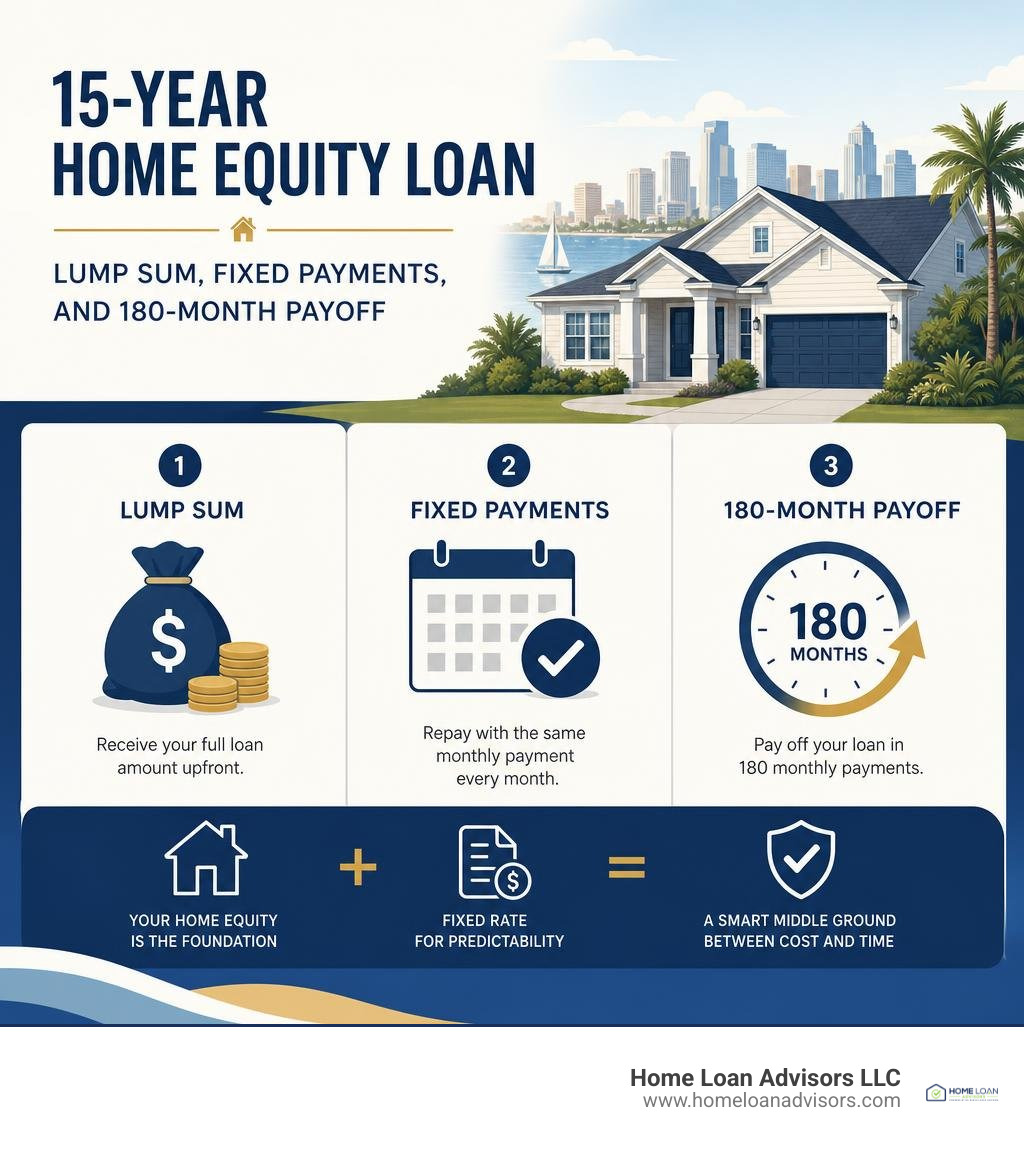
A 15-year home equity loan gives you a lump sum secured by your home, then spreads repayment across 180 fixed monthly payments. It may fit Tampa Bay homeowners who want a predictable payment and a faster payoff than a longer-term loan, without the higher monthly cost that often comes with a 10-year term.
Before choosing one, compare:
- The payment against your real monthly budget
- Total interest across 10-, 15-, and 20-year terms
- Your available equity, credit profile, debts, and lender fees
- A fixed-rate home equity loan versus a variable-rate HELOC if you need funds over time
For homeowners in Tampa, St. Petersburg, Clearwater, and nearby communities, this can be a way to finance one defined expense while leaving an existing first mortgage in place. But it is still a second mortgage, so your home secures the debt and the payment needs to be sustainable even if your budget changes.
I'm Josh Jampedro, a Tampa mortgage broker and vice president, and I help Florida homeowners sort through home financing choices in plain English.
Understanding How 15 Year Home Equity Loans Work
A 15-year home equity loan is structured as a second mortgage on your property. When you take out this type of financing, a lender gives you the total borrowed sum upfront in one lump-sum disbursement. From that moment forward, you repay the debt through 180 monthly installments composed of both principal and interest.
Because the interest rate remains fixed for the entire 180-month term, your required monthly principal and interest payment does not change. That level of predictability makes financial planning straightforward. For an overview of 15-year home equity loan mechanics, it helps to look at how equity serves as collateral.
Equity is simply the difference between what your property is worth in the current market and the remaining balance on any existing liens. For example, if you own a home in St. Petersburg that has appreciated substantially, that accumulated value can back your second mortgage.
However, since this loan sits in a junior lien position behind your primary mortgage, the lender assumes more risk. If a default occurs, the primary lender gets repaid first from the proceeds of a sale. This lien position directly influences the terms and guidelines lenders set for fixed-rate secondary financing.
How 15 Year Home Equity Loans Differ From Revolving HELOCs
Homeowners frequently weigh fixed home equity loans against home equity lines of credit (HELOCs). While both use your home as collateral, their mechanics differ fundamentally:
- Disbursement: A fixed home equity loan delivers your entire borrowing amount on day one. A HELOC acts like a revolving line of credit that you draw from as needed during an initial draw period.
- Interest Rate Structure: Fixed equity loans offer an unchanging rate throughout the full 15 years. HELOCs typically carry variable interest rates tied to a benchmark, meaning your payments can rise or fall over time.
- Repayment Terms: With a fixed loan, you begin paying principal and interest immediately across 180 equal payments. A HELOC often permits interest-only payments during the draw period, followed by a principal-and-interest repayment phase that can cause a noticeable jump in monthly obligations.
If you have a defined, one-time cost—such as a major roof replacement or a planned home addition—a fixed loan provides a locked-in timeline. If you have ongoing, staggered expenses, a revolving line might offer more flexibility, though it comes with rate variability.
Evaluating 15-Year Terms Against Primary Mortgage Options
You might also wonder whether to take out a separate second mortgage or replace your entire primary loan. A cash-out Refinance involves replacing your existing primary loan with a brand-new, larger mortgage and taking the difference in cash.
If you secured a low interest rate on your primary mortgage years ago, replacing the entire balance with a new loan could significantly raise your monthly housing expense. A 15-year home equity loan leaves your existing first mortgage untouched. You simply add a secondary monthly payment while keeping your original terms intact.
Alternatively, some homeowners choose a full reset by refinancing into a standalone 15 Year Fixed Mortgage if their existing rate is comparable to current market levels and they want to clear their primary debt rapidly. Reviewing both paths helps ensure you do not inadvertently surrender favorable financing terms on your main mortgage.
Term Comparisons: 10-Year, 15-Year, and 20-Year Equity Financing
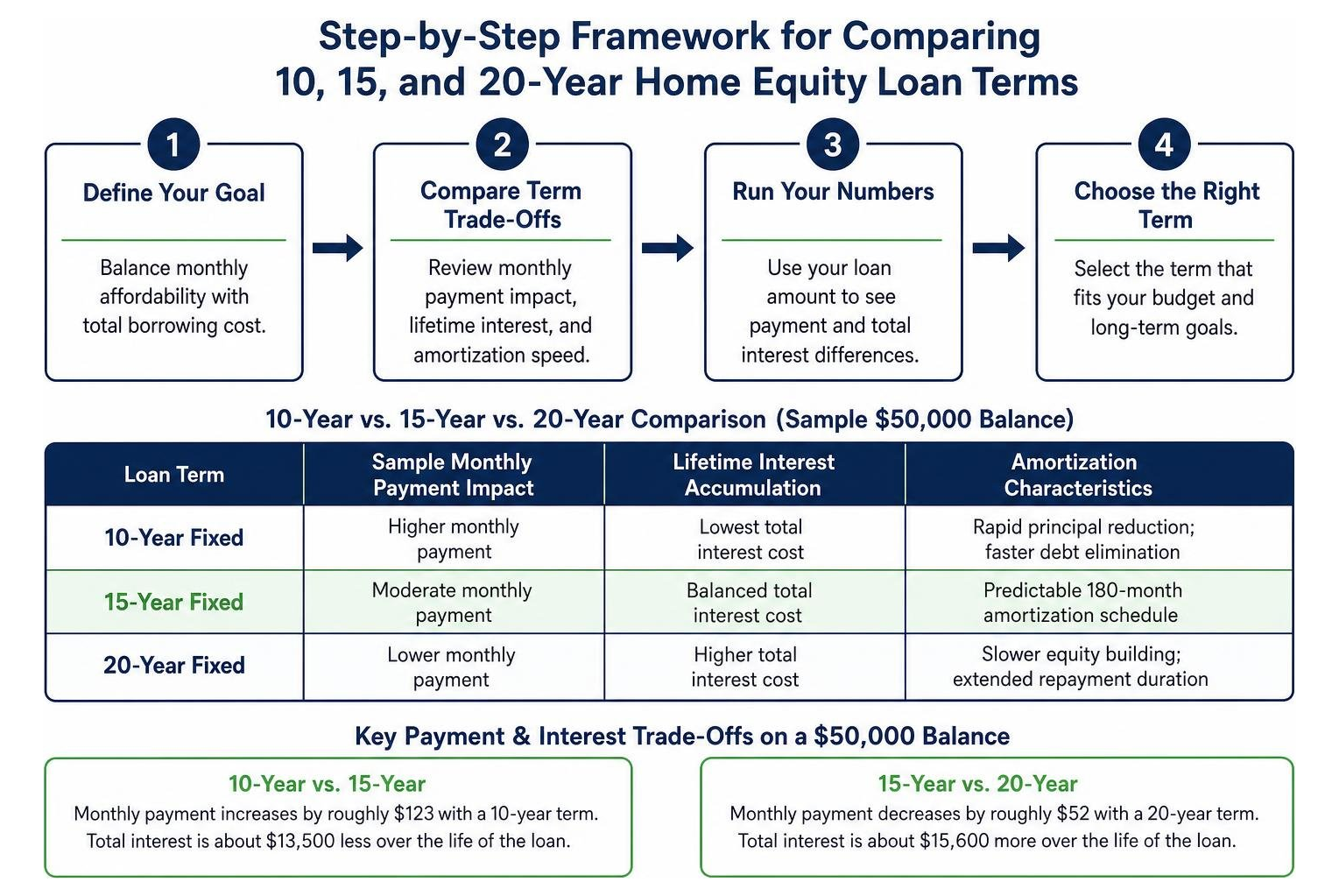
Choosing the right repayment duration requires balancing monthly affordability with overall borrowing costs. The 15-year term sits directly in the middle of standard fixed offerings, providing a middle ground between rapid debt reduction and manageable monthly cash outflow.
Examining 15 Year Home Interest Rates alongside other term lengths shows clear trade-offs in amortization velocity and cumulative interest expense:
| Loan Term | Sample Monthly Payment Impact | Lifetime Interest Accumulation | Amortization Characteristics |
|---|---|---|---|
| 10-Year Fixed | Higher monthly payment | Lowest total interest cost | Rapid principal reduction; faster debt elimination |
| 15-Year Fixed | Moderate monthly payment | Balanced total interest cost | Predictable 180-month amortization schedule |
| 20-Year Fixed | Lower monthly payment | Higher total interest cost | Slower equity building; extended repayment duration |
Monthly Payment Impact Versus Lifetime Interest Expense
When comparing a 10-year, 15-year, and 20-year term on a sample $50,000 balance, the mathematical differences become practical:
- 10-Year vs. 15-Year: Moving from a 10-year term to a 15-year term on a $50,000 balance can lower your monthly commitment by roughly $123. However, spreading repayment out across five additional years adds approximately $13,500 in total interest paid over the life of the loan.
- 15-Year vs. 20-Year: Stretching that same $50,000 balance from 15 years to 20 years saves only about $52 per month in cash flow, but it adds roughly $15,600 in additional interest expense over time.
You can run your own numbers on a 15-year loan payment estimator to see how these dynamics apply to your specific property in Clearwater or surrounding areas. The key is finding a monthly payment that does not squeeze your household budget while avoiding unnecessary interest buildup.
Comparing Shorter and Longer Fixed-Rate Alternatives
If your primary focus is keeping your required monthly payment as low as possible, a longer-term option such as a 30 Year Fixed Mortgage structure or an Adjustable Rate Mortgage might come up in your research.
Shorter terms demand higher monthly cash flow, but they clear principal significantly faster. Longer terms reduce immediate monthly strain, yet they carry a higher lifetime borrowing cost. A 15-year equity loan functions as a structured middle path for homeowners who want a clear end date within a manageable timeline.
Evaluating Costs and Calculating Payments for Florida Homeowners
When evaluating 15 year home equity loans, your total payment and amortization curve depend on the loan size, interest rate, and term length. Using a comprehensive Mortgage Calculator allows you to model how these variables interact.
In the early years of a 15-year amortization schedule, a larger portion of each payment covers interest charges, with the remainder reducing principal. As the balance declines over the 180 payments, the ratio flips, directing the vast majority of your monthly installment toward principal by the final years.

Beyond principal and interest, borrowers must account for closing costs and transaction fees. These can include:
- Property appraisal or automated valuation fees
- Title search and lender title insurance
- Loan origination or processing charges
- Florida state documentary stamp taxes and intangible taxes on recorded mortgages
Key Factors Influencing Rates on 15 Year Home Equity Loans
Lenders evaluate several components when determining your fixed interest rate and loan terms:
- Credit Profile: A higher credit score demonstrates consistent debt management and generally secures more favorable pricing.
- Combined Loan-to-Value (CLTV): This is the sum of all existing mortgages plus your requested home equity loan, divided by the appraised value of your property. Lower CLTV ratios represent less risk to the lender.
- Debt-to-Income (DTI) Ratio: Lenders look at your total recurring monthly debt payments relative to your gross monthly income to ensure you have sufficient margin for the new payment.
- Lender Margins and Local Conditions: Underlying market conditions and individual lender guidelines affect overall pricing and closing requirements across Florida.
Qualification Requirements and Borrower Suitability
To qualify for secondary fixed-rate financing, you must meet basic financial benchmarks established by underwriting guidelines. While specifics vary between institutions, common standards across Hillsborough County and Pinellas County include:
- Equity Thresholds: Most lenders require you to retain at least 15% to 20% equity in your home after accounting for both the primary mortgage and the new equity loan (capping CLTV around 80% to 85%).
- Credit Score Guidelines: While minimum thresholds vary, higher credit scores open access to broader program choices and competitive rate structures.
- Income and Employment Verification: Borrowers need documented proof of stable income through tax returns, W-2s, or pay stubs, ensuring your overall DTI ratio remains within acceptable limits.
When a 15-Year Fixed Term Fits Your Financial Strategy
A 15-year fixed home equity loan may fit your strategy if:
- You have a specific, fixed-cost financial need (such as whole-home renovations or high-interest debt payoff) and want a lump-sum distribution.
- You prefer the stability of an unchanging monthly payment that will not fluctuate with benchmark rate changes.
- You want to pay off your secondary debt within 15 years rather than carrying it across multiple decades.
- Your existing primary mortgage carries favorable terms that you prefer not to replace.
Frequently Asked Questions About 15-Year Home Equity Financing
What is the typical shortest term available for a fixed home equity loan?
Fixed-rate home equity loans are commonly available in terms as short as 5 to 10 years, depending on the lender. While shorter terms reduce total interest costs, they come with higher monthly payments that require greater budget flexibility.
Can you pay off a 15-year home equity loan early without prepayment penalties?
In many cases, lenders allow borrowers to make extra principal payments or pay off the balance entirely ahead of schedule without penalty. However, terms vary by contract, so you should review the loan disclosures carefully to confirm whether any early payoff or account closure fees apply.
What credit score and equity are needed to qualify for a home equity loan?
Lenders evaluate your credit profile alongside your combined loan-to-value (CLTV) and debt-to-income (DTI) ratios. Generally, maintaining at least 15% to 20% remaining equity in your property and a solid credit history provides the widest range of financing options.
Conclusion
Choosing the right equity financing structure comes down to aligning your borrowing needs with your monthly cash flow and long-term payoff objectives.
At Home Loan Advisors LLC, I take an educational, advisor-first approach to mortgage lending. With over a decade of experience and more than 1,000 closed transactions throughout Tampa, St. Petersburg, Clearwater, and across Florida and Wisconsin, I help you evaluate your choices clearly.
If you are exploring secondary financing or considering a full 15-Year Fixed Mortgage, let's discuss what makes sense for your personal situation.
Connect with Josh Jampedro:
- NMLS:#1082889 (Flagged for human compliance review of placement requirements and applicable loan program eligibility language)
- Website: joshjampedro.com
- LinkedIn: linkedin.com/in/josh-jampedro
- Facebook: FLHomeLoanAdvisors
- Instagram:@joshjampedro
- YouTube:@BetterRate
Equal Housing Lender.
Mortgages are complex so let me give you the tools you need to make the right decisions.